Africa U19 Talent Intelligence: Exploring European Pathways Through AI-Assisted Scouting
Introduction
African football continues to offer significant opportunities for talent identification, particularly across emerging clubs, academies and youth development programmes operating beyond the most extensively monitored markets.
For European football organisations, identifying young talent represents only the beginning of a wider process. Understanding where a player might develop, which competitive environments could suit their characteristics and how their progression could be structured is equally important.
Football Planet Global has undertaken an exploratory research initiative examining ten emerging U19 footballers from African development environments, combining available player information with AI-assisted research to consider potential European league pathways.
Africa U19 Talent Intelligence — Top 10
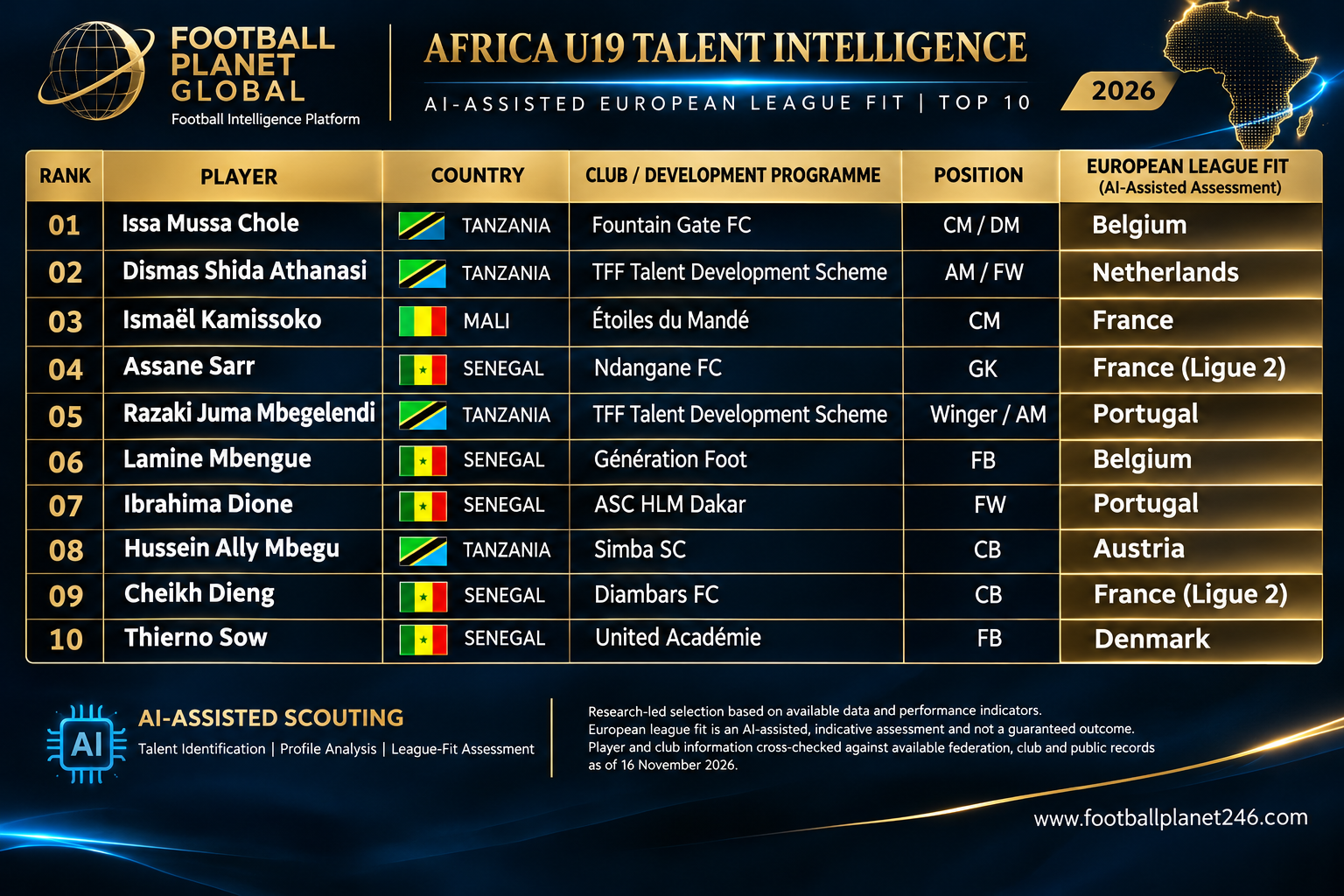
The selection brings together young players associated with football development structures in Tanzania, Senegal and Mali.
The research considers available player information, reported performance indicators, tournament recognition and positional profiles, where such evidence could be identified.
Rather than concentrating exclusively on established African talent-exporting markets, the initiative seeks to broaden the geographical scope of early-stage scouting research.
The accompanying Africa U19 Talent Intelligence — Top 10 table presents the selected players, their reported clubs or development programmes, positional classifications and indicative European league destinations.
Among the proposed pathways, Belgium and the Netherlands emerge as potential environments for selected midfield profiles, while Portugal features in the assessment of attacking players.
France, including Ligue 2, also appears among the indicative destinations, alongside Austria and Denmark.
These associations represent research-based suitability hypotheses, not confirmed recruitment recommendations.
AI-Assisted European League Fit
The second dimension of the initiative examines a question extending beyond initial talent identification:
Which European football environments might provide suitable conditions for a young player's next stage of development?
League suitability cannot be determined solely by nationality, position or technical characteristics.
Competitive intensity, tactical demands, playing opportunities, physical development, coaching structures and adaptation requirements can all influence a player's progression.
AI-assisted research can help organise information and generate initial comparisons between player profiles and potential league environments.
However, these comparisons must remain subject to further scrutiny.
In this initiative, the European league associations are indicative assessments. They do not result from a validated predictive model, nor do they establish that individual players possess the attributes required to succeed in those competitions.

From Discovery to Development Pathways
For Football Planet Global, the longer-term objective is to explore how structured research and technology-assisted scouting can support more informed decisions across international talent markets.
The identification of an emerging player should ideally lead to further investigation of his sporting background, development needs and potential progression opportunities.
That process requires additional match observation, reliable performance evidence, verification of player information and consideration of the practical realities of international recruitment.
Artificial intelligence can contribute to the research process, but it does not replace independent scouting judgement or direct assessment.
The Football Planet Perspective
The Africa U19 Talent Intelligence initiative represents an initial exploration of how AI-assisted research can contribute to talent discovery and the identification of potential European development pathways.
Its value lies in generating structured questions and identifying candidates for deeper evaluation, rather than presenting definitive conclusions about future careers.
The next stage is verification: transforming preliminary research into evidence-based scouting intelligence.
Editorial note: This is an exploratory research selection, not a validated predictive ranking. Player ages, current club registrations, positional information and development pathways require final independent confirmation. European league-fit assessments are indicative and do not constitute guaranteed predictions or transfer recommendations.