Why Europe Misses Out on Thousands of African Talents Every Year
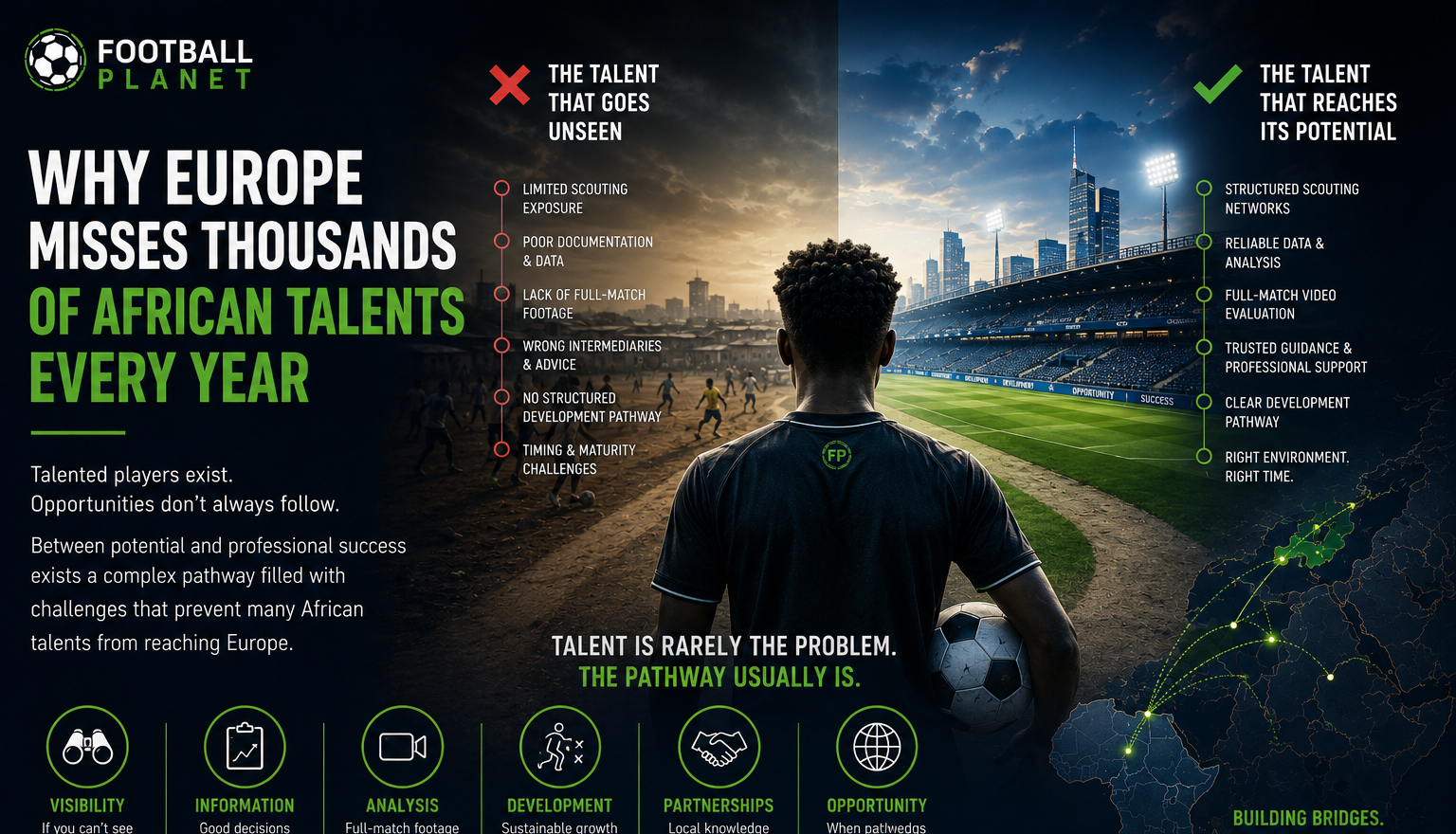
Talent Exists. Opportunity Doesn't Always Follow.
Every year, thousands of talented young footballers across Africa dream of playing professionally in Europe. They possess technical ability, athleticism, creativity, and determination. Many dominate local competitions and attract attention within their communities. Yet, only a small percentage ever reach European clubs.
The reason is often misunderstood. It is not because Africa lacks talent. In fact, many of today's top footballers have demonstrated that the continent continues to produce exceptional players capable of succeeding at the highest level. The real challenge lies elsewhere: the pathway between talent and opportunity is often incomplete.
The Visibility Gap
One of the biggest obstacles is visibility. Europe cannot recruit players it does not know exist. While elite academies and international youth tournaments receive significant scouting attention, countless talented players compete in regional leagues, community academies, and local competitions with little or no exposure. Without structured scouting networks, reliable contacts, or consistent monitoring, many promising careers remain unnoticed.
The Need for Comprehensive Data
Another challenge is the lack of comprehensive player information. Modern recruitment extends far beyond watching a few highlights. Clubs increasingly evaluate full-match performances, tactical understanding, decision-making, physical profile, injury history, character, consistency, and long-term development potential. When this information is unavailable or poorly documented, even highly talented players become difficult to assess with confidence.
Highlights vs. Full-Match Footage
Video footage also plays a significant role. Many players are represented only by short highlight compilations designed to showcase their best moments. While these videos can demonstrate technical ability, they rarely reveal how a player performs throughout an entire match. Scouts and recruitment departments prefer complete match footage because it allows them to evaluate positioning, defensive contribution, decision-making under pressure, movement without the ball, and overall football intelligence.
The Crucial Role of Timing & Adaptability
Timing can be equally decisive. Some players are introduced to European clubs too early, before they are physically or mentally prepared for the demands of professional football. Others are presented too late, after important development opportunities have already passed. Identifying the right player at the right stage of development remains one of the most challenging aspects of recruitment.
The human element is equally important. Adaptation to a new country, language, culture, and football environment requires resilience and maturity. European clubs increasingly value professionalism, learning ability, discipline, and psychological readiness alongside technical quality. Talent may open the first door, but character often determines whether a player successfully progresses through it.
Minimizing Risk in Modern Scouting
The recruitment process itself has also become far more selective. Clubs now combine live scouting, video analysis, performance data, and background information before making investment decisions. A player who lacks reliable information in just one of these areas may be overlooked, not because of insufficient ability, but because uncertainty creates unnecessary risk.
This reality highlights an important distinction: identifying talent is not the same as developing talent. Sustainable player pathways require cooperation between academies, coaches, scouts, analysts, and clubs. Structured development, accurate evaluation, and responsible guidance provide young footballers with opportunities that extend beyond individual ability alone.
A Strategic Opportunity for European Clubs
For European clubs, improving access to under-scouted regions represents both a sporting and strategic opportunity. Expanding recruitment networks, building trusted local partnerships, and investing in long-term talent identification can reveal players who might otherwise remain invisible. In an increasingly competitive transfer market, discovering potential before everyone else has become a genuine competitive advantage.
Africa continues to produce footballers capable of succeeding at every level of the game. The challenge is not finding talent—it is building reliable bridges between that talent and the professional opportunities waiting on the other side.
The future of global recruitment will not belong solely to those who scout the most players. It will belong to those who understand how to identify potential, evaluate it responsibly, and create pathways that allow talent to flourish wherever it is found.