Morocco’s Football Talent Pipeline: Developed at Home, Refined Across Europe
Introduction
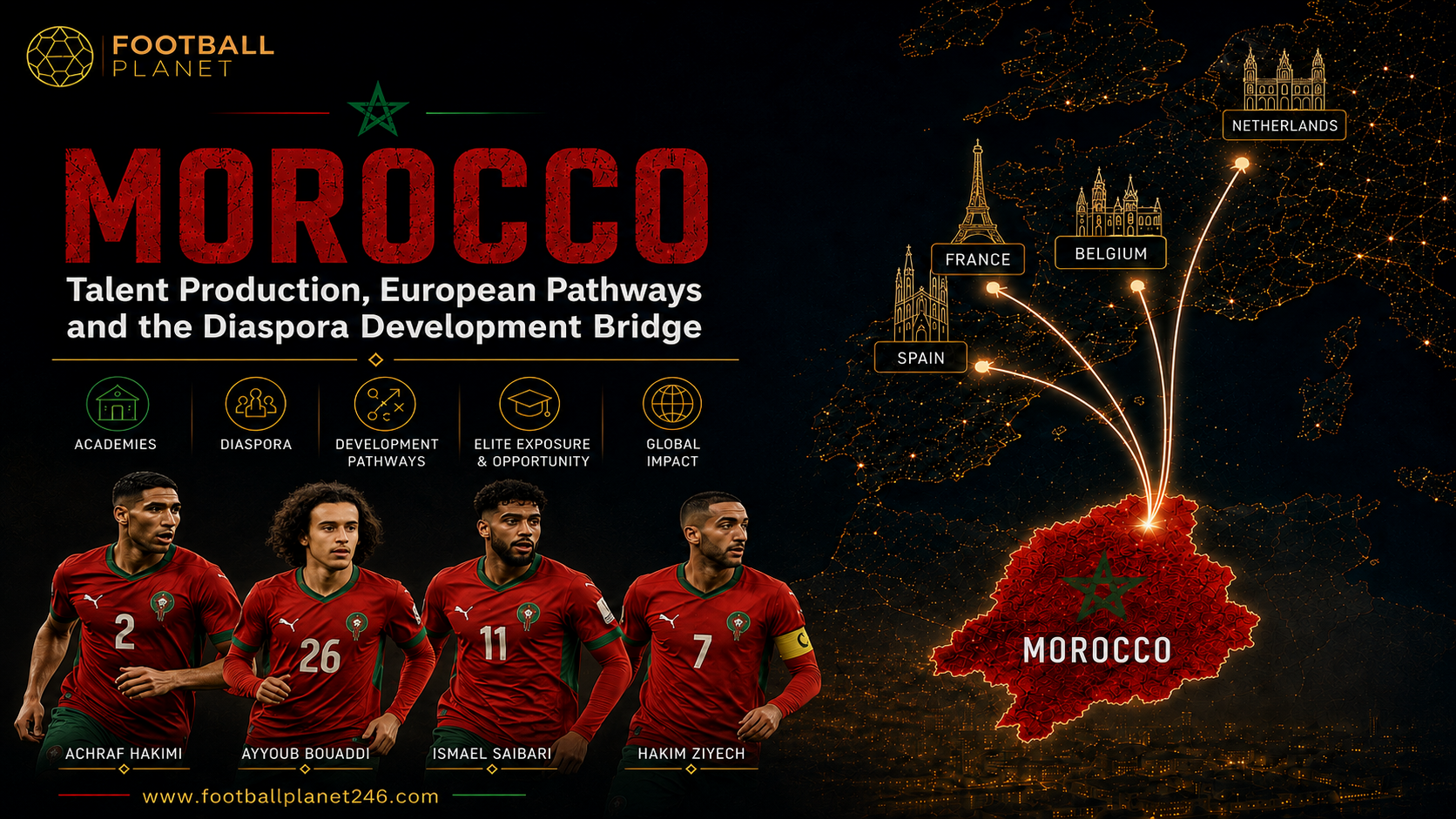
Morocco’s rise in international football is often discussed through results, tournaments and individual stars. Yet behind those visible outcomes sits a more interesting development story. The country is drawing talent from two complementary football environments. The first is domestic: academies, federation-backed development structures and increasingly sophisticated club pathways inside Morocco. The second exists across Europe, where generations of players from Moroccan families have grown up inside some of the continent’s strongest football cultures — particularly in France, Belgium, the Netherlands and Spain. These pathways were not created through the same process. Migration and diaspora development are social realities, not football strategies. But Morocco has become increasingly effective at connecting this European-developed talent pool with a strengthening domestic system. The result is a football ecosystem with unusual depth.
The Domestic Development Engine
Morocco has invested heavily in building a stronger structure for identifying and developing young players at home. The Mohammed VI Football Academy has become one of the most visible examples. Established in 2009, it was designed to identify talent across Morocco, provide structured football and educational development, and prepare players for professional careers. Players including Nayef Aguerd, Youssef En-Nesyri and Azzedine Ounahi have passed through the academy system. The development strategy has since expanded beyond one institution. In 2026, the Royal Moroccan Football Federation reported that FIFA had positively evaluated its national youth-development programme after visiting clubs including Wydad, Raja, FUS Rabat and RS Berkane. FIFA support has also included work around infrastructure, coaching development and talent-development structures. This matters because sustainable talent production cannot depend on one academy. A functioning pathway requires identification, coaching, competition, facilities and access to senior football across multiple institutions. Morocco increasingly appears to be building that broader framework.
The European Diaspora Advantage
At the same time, another Moroccan talent pipeline has developed thousands of kilometres away. Large Moroccan communities across Western Europe have produced players who received their football education inside established European academy systems. That creates a powerful developmental advantage. A player growing up in Belgium may experience highly structured positional education and academy competition from an early age. A player developing in the Netherlands may enter a football culture strongly associated with technical development, tactical understanding and youth integration. Spain provides another environment shaped by possession, combination play and technical detail. Morocco does not control these systems. But it benefits from players who emerge from them. Ismael Saibari illustrates the pathway particularly well. Born in Spain, he later moved with his family to Belgium, progressed through Anderlecht and Genk, and eventually joined PSV in the Netherlands. His development therefore crossed three different European football environments before he became established with Morocco. That kind of journey creates more than technical ability. It exposes players to different coaching methods, tactical expectations and competitive cultures.
Belgium and the Netherlands: A Valuable Development Corridor Belgium and the Netherlands are especially interesting when examining Morocco’s European talent base. Both markets have long histories of developing young players and giving technically capable prospects routes into professional football. For Morocco, the value is not simply that players are born or raised there. It is that they can receive years of structured football education before entering international football. This creates players who may already understand pressing structures, positional rotations, transition moments and different interpretations of attacking or defensive roles. The Moroccan national setup can then integrate those players alongside footballers developed domestically. The outcome is a squad built from different football educations rather than one uniform pathway.
Spain: Technique, Identity and Competitive Exposure
Spain represents another important dimension. Players of Moroccan heritage growing up there can be exposed to a culture where technical execution, spatial awareness and combination play are deeply embedded in youth football. The pathway is also culturally significant because of the geographic and historical proximity between Morocco and Spain. For recruitment departments, this creates interesting profiles: players may carry Moroccan eligibility while already possessing several years of development within Spanish football structures. The wider Moroccan talent pool therefore cannot be understood simply by scouting the Botola or Moroccan academies. It extends across European youth and professional football.
One Talent Pool, Multiple Football Educations
This is where Morocco’s model becomes particularly interesting. A national team or recruitment network can draw from players developed: inside Morocco, in Belgium, in the Netherlands, in Spain, in France and elsewhere. These players arrive with different football experiences but share access to the same international pathway. Morocco has also become increasingly active in maintaining relationships with dual-national players. FIFA has highlighted both the federation’s domestic development work and its ability to attract players developed abroad, while Moroccan technical figures have openly recognised the importance of the European-based talent network. (FIFA) The competitive advantage is therefore not simply population size or diaspora size. It is the ability to identify, connect and integrate talent produced through different systems.
What Recruitment Departments Can Learn
There is an important lesson here for clubs and scouting departments. Talent markets should not always be defined geographically. A Moroccan prospect may be playing in Casablanca, Brussels, Rotterdam, Lille or Madrid. The nationality may be the same, but the development environments can be completely different. Modern recruitment therefore requires understanding not only where a player comes from, but also:
- where he was developed,
- what tactical education he received,
- what competition he experienced,
- and how transferable those qualities may be to the next environment.
Morocco is a particularly strong example of why football pathways increasingly cross borders long before the transfer market becomes involved.
Final Thoughts
Morocco’s emerging football strength is being built through more than one system. Domestic academies and federation-led investment are creating stronger structures at home, while the European diaspora continues to produce players educated inside some of the continent’s most advanced football environments. These two pathways are different, but increasingly complementary. The result is a broad talent pool shaped by multiple football cultures, multiple development routes and one increasingly connected national ecosystem. For Football Planet, that is what makes Morocco especially interesting: not simply the number of talented players it produces, but the variety of environments through which that talent is being developed.