Kieron Lovelady: Connecting Elite Coaching, Performance Analysis and Player Development
Introduction
The transition from academy football to the senior professional game presents challenges for both players and coaches.
Technical knowledge and tactical understanding remain essential, but developing footballers also requires effective communication, individualised learning and the ability to adapt to different competitive environments.
Kieron Lovelady has experienced these demands across several levels of professional football.
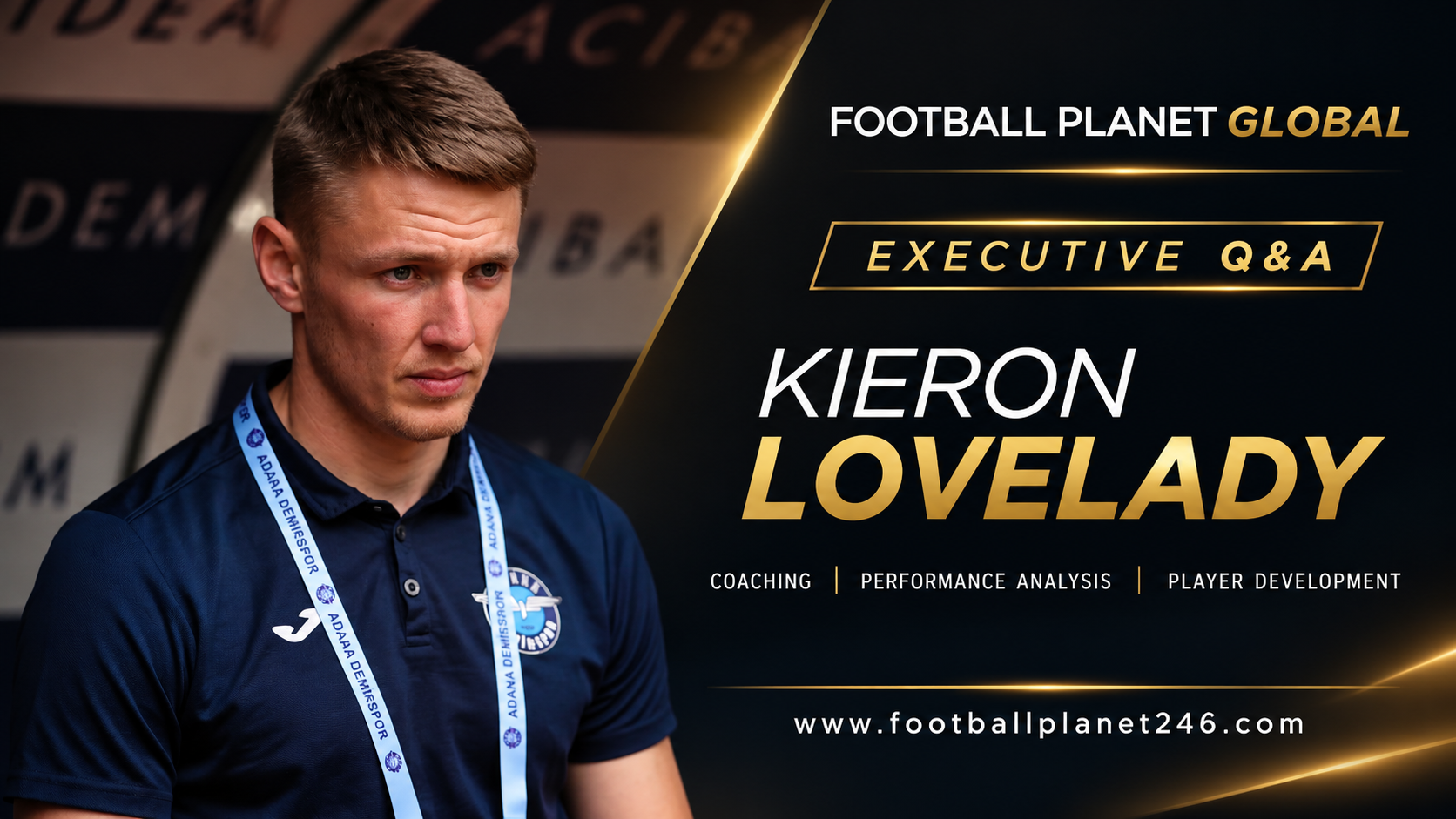
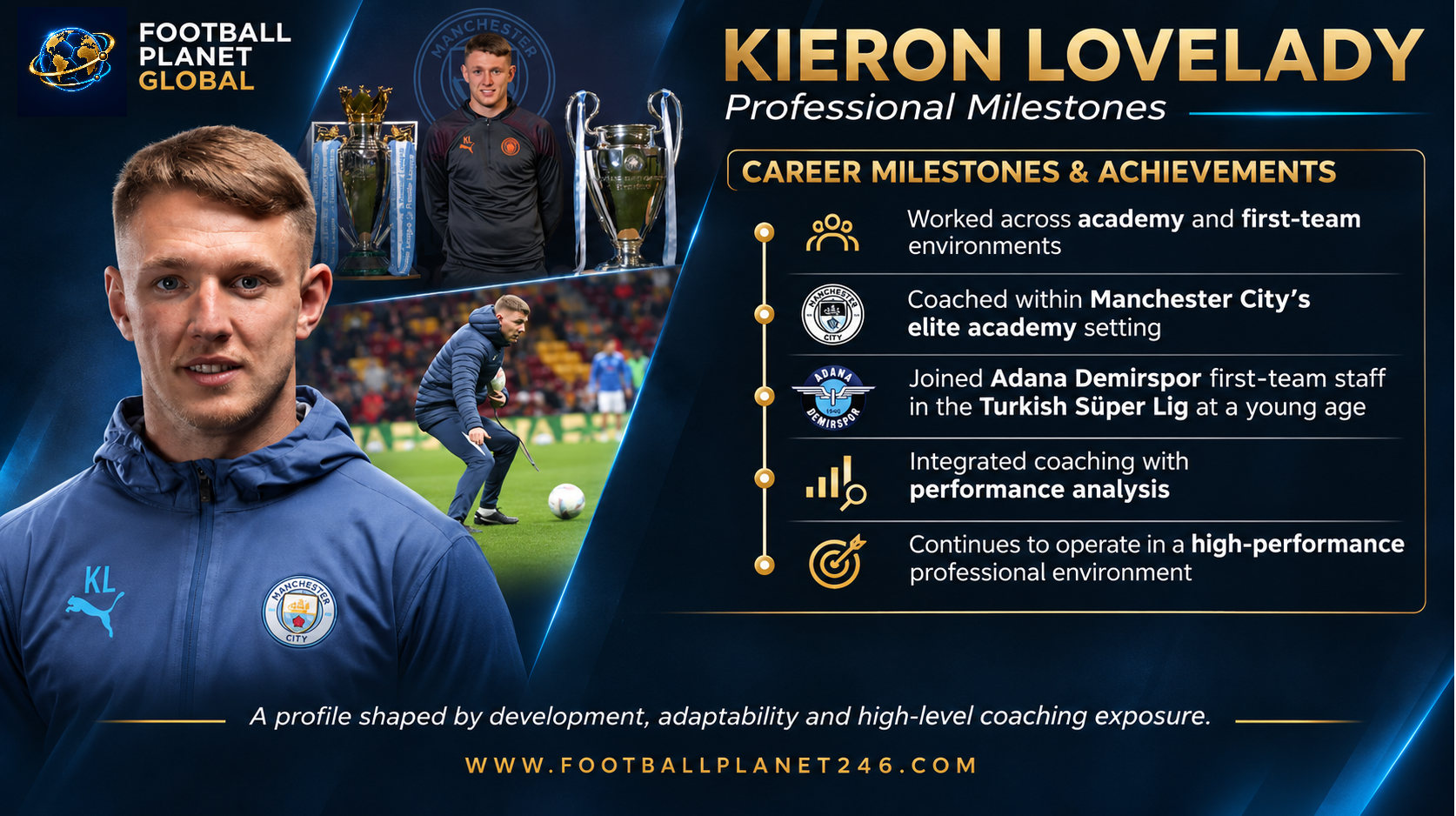
His coaching journey has taken him from youth development roles in England to Manchester City's academy, followed by a move into the Turkish Süper Lig with Adana Demirspor at the age of 27.
In July 2025, he joined Cardiff City in a first-team coaching and analysis role, bringing together experience in player development, tactical preparation and performance analysis.
In this written Executive Q&A with Football Planet Global, Lovelady reflects on his professional development, the lessons learned within elite academy football, the challenges of coaching abroad and the relationship between analysis and practical training.
He also offers his perspective on the qualities that will increasingly shape coaching and player development over the coming decade.
1. Building a Coaching Career: Lessons from Different Environments
Football Planet Global: You began coaching at a relatively young age and have since worked across academy and first-team football. What have been the most important lessons from your journey, and what advice would you give to young coaches looking to build a career in professional football?
Kieron Lovelady:
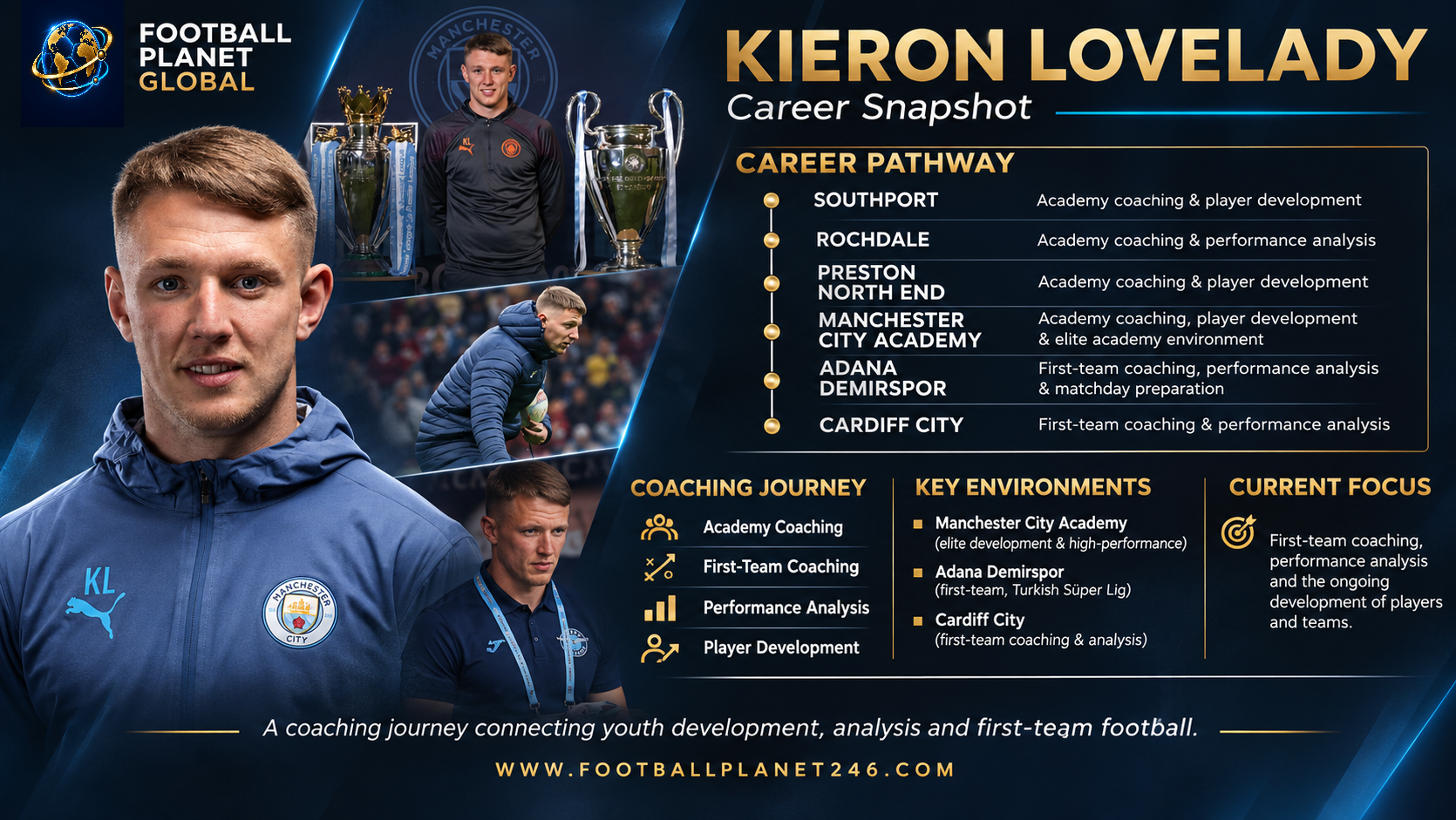
I started coaching at a relatively young age, which gave me the opportunity to gain experience across different environments and age groups early in my career. I was fortunate to work with Southport FC my local team with the U18’s Rochdale across multiple age groups where and EFL League One club at the time and Preston North End where I lead the U15’s before progressing into Manchester City’s elite academy and eventually first-team environments.
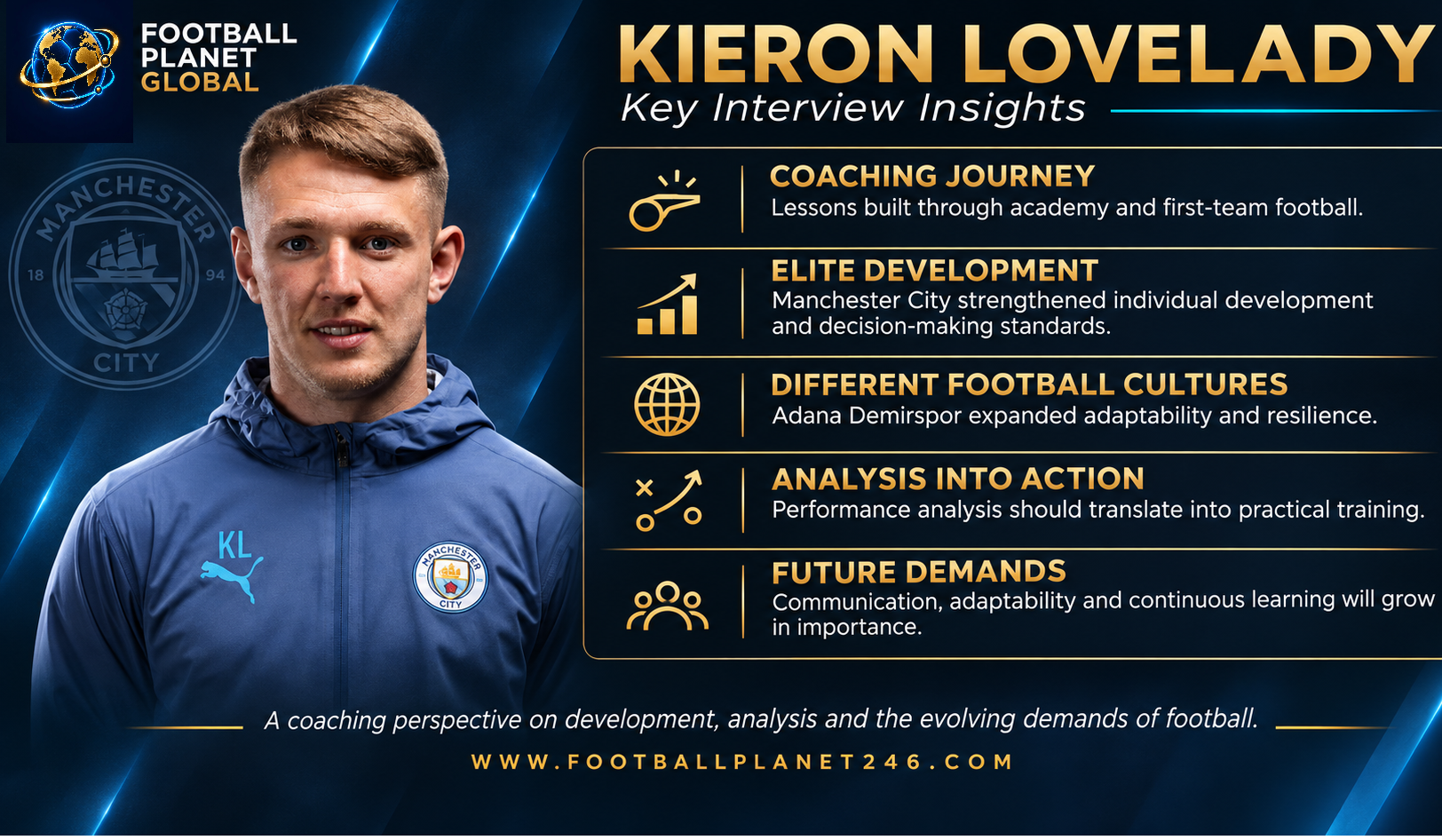
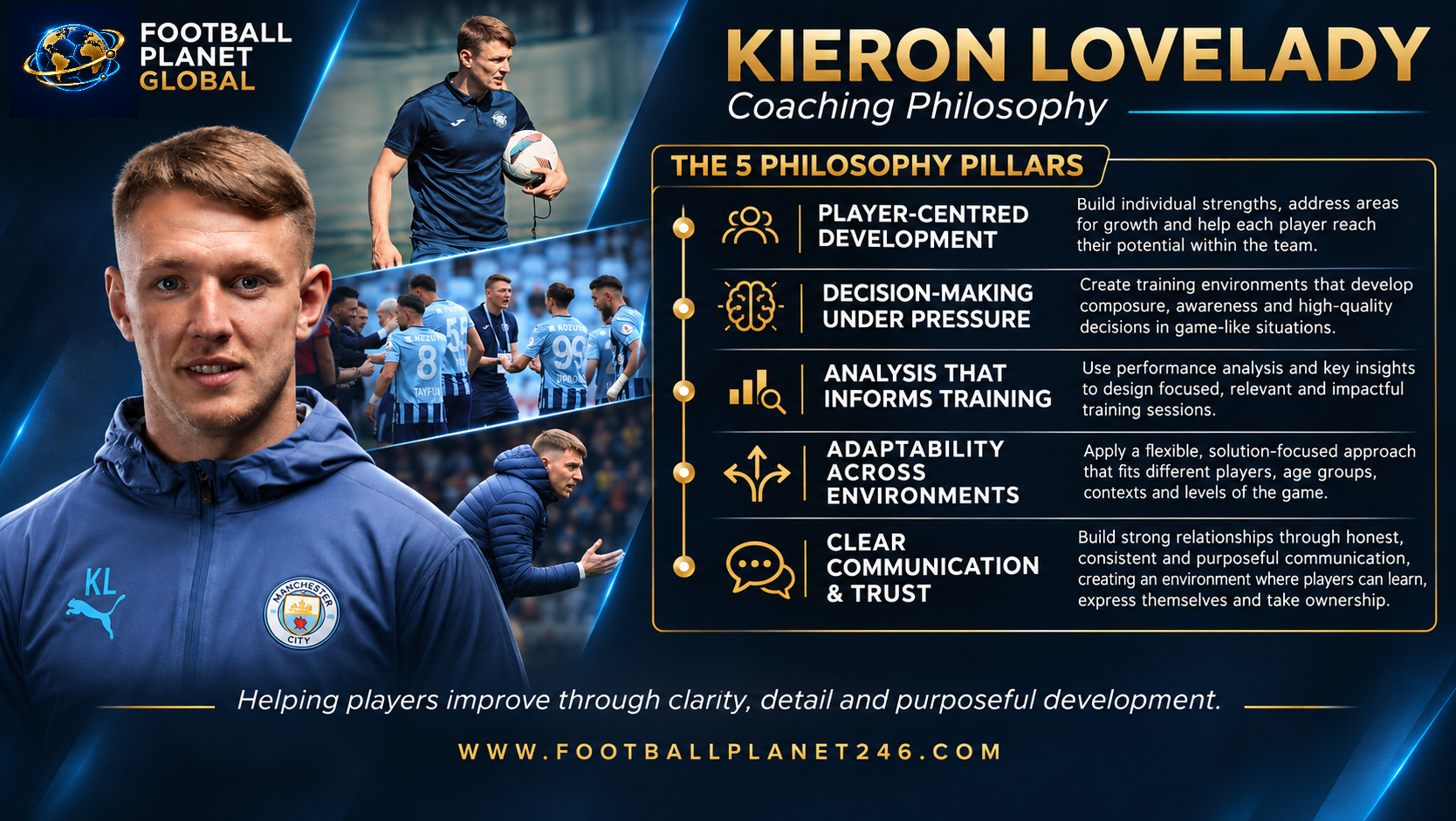
One of the biggest lessons has been understanding that coaching is about much more than delivering sessions. Building relationships, understanding individuals, creating the right environment and being able to communicate effectively are just as important as your tactical and technical knowledge.
My experiences at Manchester City, Adana Demirspor and Cardiff City have also taught me that you have to remain adaptable. Football is constantly evolving, and as a coach you need to be willing to challenge your own ideas, learn from others and continually develop.
My advice to young coaches would be to focus on becoming as knowledgeable and well-rounded as possible. Take opportunities, work hard, build relationships and don’t become too focused on job titles or how quickly you progress. Every experience offers something valuable. Most importantly, understand the game, but never lose sight of the people you are coaching.
2. Youth Development at Manchester City
Football Planet Global: Having worked within Manchester City's academy structure, what did that environment teach you about developing young players, particularly in terms of individual development, decision-making and preparing them for senior football?
Kieron Lovelady:
My time at Manchester City was extremely valuable, particularly in understanding what an elite player development environment should look like. I spent three seasons within the academy, and I was there during the first teams treble-winning season, and had the opportunity to work with some outstanding players and coaches.
One of the biggest things I took from the experience was the importance of individual development. Although players operate within a team structure, every player has different strengths, weaknesses and development needs. Having a clear understanding of those individual requirements and translating them into meaningful Individual Development Plans is essential.
I also believe decision-making is one of the most important areas of development. It’s not simply about whether a player can execute a technical action, but whether they can recognise the right action, at the right time, under pressure. Training must therefore challenge players cognitively as well as technically.
Another important lesson was the connection between academy football and senior football. Development should always have a long-term perspective, but players also need to understand the demands and expectations of the professional game. My subsequent experiences in first-team football have reinforced how important that transition is.
Ultimately, developing players is about preparing them to become effective footballers at the highest possible level, not simply producing good academy players.
3. The Experience in Turkish Football
Football Planet Global: At just 27, you joined the first-team coaching staff of Adana Demirspor in the Turkish Süper Lig. What were the biggest challenges of working in a different football culture and a demanding professional environment, and how did that experience shape your coaching philosophy?
Kieron Lovelady: Joining Adana Demirspor’s first-team coaching staff at 27 was a significant opportunity and one that challenged me both professionally and personally. The move made me the youngest first team coach in Europes top 10 leagues at the time.
Moving into the Turkish Süper Lig meant adapting to a different football culture, a different working environment and the expectations that come with professional first-team football. The passion surrounding football in Turkey is enormous, and the emotional connection supporters have with their clubs creates a unique atmosphere.
One of the biggest challenges was learning how to adapt my communication and approach to a new environment, working with players from different nationalities and backgrounds while maintaining clear standards and expectations.
It also gave me a different perspective on player development. Through the academy transition programme, we created opportunities for young players to progress into the first team, resulting in eight senior debuts. Being able to contribute to that pathway while working in a demanding senior environment was particularly rewarding.
The experience reinforced my belief that good coaching requires adaptability. You need to have a clear identity and philosophy, but you must also understand the environment, the players and the demands of the club. It strengthened my desire to work in senior football and ultimately pursue my ambition of becoming a first-team manager.
4. Connecting Performance Analysis with Coaching and Individual
Development Football Planet Global: Your role at Cardiff City combines first-team coaching and performance analysis. How do you connect tactical analysis with practical training sessions and individual player development to help footballers improve their performance?
Kieron Lovelady: I believe coaching and analysis should be closely connected. Analysis is only valuable if it helps players understand the game better and translates into improvements on the training pitch and during matches.
At Cardiff City, my role involved both first-team coaching and performance analysis, which allowed me to connect those two areas on a daily basis.
For me, the starting point is identifying what we want to improve as a team and as individuals. Through video analysis, we can highlight specific situations, behaviours and decisions that are relevant to our game model. However, rather than simply showing players what went wrong, it’s important to provide solutions and explain how we can improve.
Those learning points can then be transferred into training through practices that replicate the demands of the game. This might involve tactical positioning, decision-making, movements within a particular phase of play or attacking and defensive behaviours.
Individual development is equally important. Players need to understand their own strengths, areas for improvement and what is required to reach the next level. Individual Development Plans provide a framework for that process, but regular communication and consistent feedback are what make them effective.
Ultimately, analysis should support coaching, not replace it. The objective is to help players understand the game, make better decisions and consistently improve their performance.
5. The Future of Coaching and Player Development
Football Planet Global: Looking at the evolution of modern football, which qualities do you believe will become increasingly important for young coaches and developing players over the next decade?
Kieron Lovelady: I think the biggest change over the next decade will be the increasing importance of adaptability, decision-making and the ability to process information quickly.
Football is becoming increasingly demanding. Players are expected to operate in different systems, understand multiple tactical roles and make decisions under intense physical and cognitive pressure. Technical ability will always be fundamental, but the players who can consistently make good decisions in complex situations will have a significant advantage.
For young coaches, I believe the ability to understand the game from multiple perspectives will become increasingly important. Coaches need to combine tactical knowledge, technical understanding, performance analysis, psychology and communication. Technology and data will continue to play a bigger role, but the ability to build relationships and influence people will remain essential.
I also believe individual development will become even more prominent. Academies must continue moving away from a purely team-focused approach and ensure they are genuinely developing individuals. Every player has a different pathway, and understanding what each individual needs at different stages of their development is crucial.
My MSc in Elite Coaching Practice, particularly my research into Elite Youth Player Development, reinforced the importance of creating environments that challenge players while allowing them to learn, make mistakes and develop.
Ultimately, the best coaches will be those who never stop learning. The game will continue to evolve, and we have to evolve with it. Having a clear philosophy is important, but being open-minded, adaptable and committed to improving yourself and the people around you is what will make the difference.
The Football Planet Perspective
Kieron Lovelady's experience across youth development and first-team football highlights an important relationship between individual learning, tactical preparation and coaching adaptability.
Three themes emerge particularly clearly from his responses.
Individual development requires more than technical improvement. Lovelady emphasises the importance of understanding each player's needs and using Individual Development Plans to connect learning objectives with long-term progression. Decision-making under pressure becomes a central part of that process.
Performance analysis must translate into practical coaching.
Video, data and tactical assessment provide information, but their value depends on whether coaches can turn that information into training practices, relevant feedback and improved decisions during matches.
Adaptability remains essential across football environments.
His experiences in England and Turkey demonstrate how communication, cultural understanding and professional expectations can shape a coach's methods without necessarily changing their underlying philosophy.
There is also a wider implication for football organisations. Investment in performance technology and analytical resources should be accompanied by investment in coaching expertise, individual development processes and effective communication.
The increasing availability of information does not automatically produce better players. Progress depends on the ability to interpret that information, understand individual requirements and apply it within appropriate training environments.
For Football Planet Global, the interview reinforces the importance of evaluating player development as an interconnected process rather than a collection of isolated technical or statistical indicators.
About Kieron Lovelady
Kieron Lovelady is an English football coach whose professional background includes youth development, academy coaching, first-team football and performance analysis.
His career has included coaching roles at Southport, Rochdale, Preston North End and Manchester City, followed by first-team experience with Adana Demirspor in the Turkish Süper Lig.
In August 2025, he joined Cardiff City in a coaching and analysis role.
His professional interests include individual player development, tactical preparation and the connection between performance analysis and practical coaching.
Editorial Credits & Disclaimer
Interviewee: Kieron Lovelady
Interview & Editorial Development: Football Planet Global — Tasos Manoli
Interview Format: Written Executive Q&A
Editorial Publication: 13 November 2026
The interviewee's responses are reproduced as provided for editorial review. The introduction, section headings, concluding analysis and biographical summary were prepared by Football Planet Global.
Professional experiences, numerical claims and personal assessments expressed in the answers represent the interviewee's own account. They should not be interpreted as independent verification by Football Planet Global.
Football Planet Global — Global Football Intelligence