From 2004 Discipline to 2026 Talent: Greece’s New Football Generation
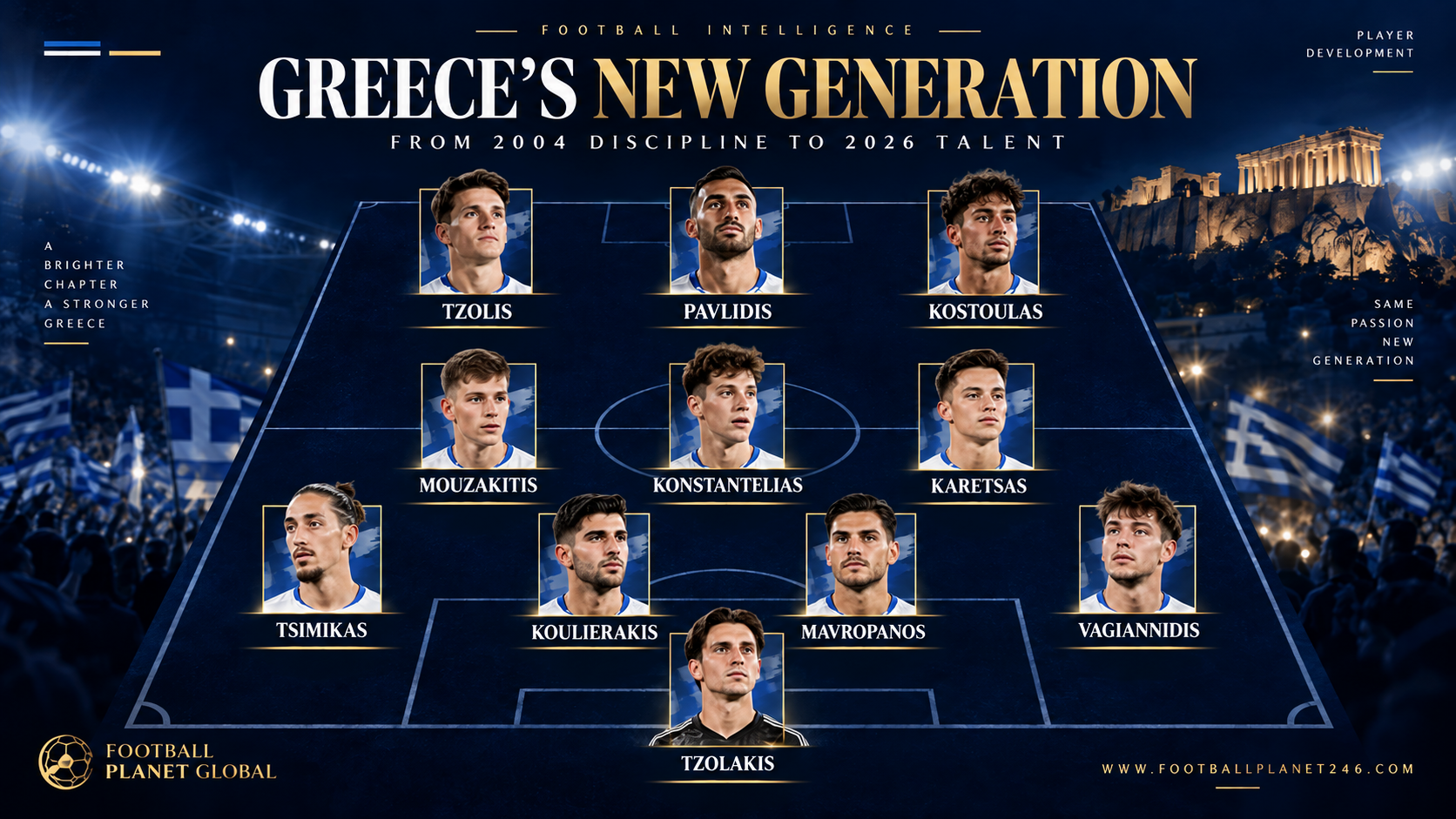
In 2004, Greece produced one of the greatest shocks in international football history.
The team that won the European Championship in Portugal was built around organisation, discipline, collective sacrifice and tactical clarity.
Twenty-two years later, the identity of Greek football is beginning to look different.
The structure remains.
But now, Greece is combining it with a much deeper pool of technical and athletic talent.
A Generation Spread Across Europe
What stands out is not one star player.
It is the number of Greek internationals now competing in strong European environments.
Kostas Tsimikas remains at Liverpool, Konstantinos Mavropanos represents West Ham, Konstantinos Koulierakis has moved to Roma, Christos Tzolis is now at Arsenal, while Giannis Konstantelias and Konstantinos Karetsas are both at Borussia Dortmund.
Further forward, Vangelis Pavlidis continues at Benfica, Fotis Ioannidis is at Sporting CP, while Charalampos Kostoulas and Stefanos Tzimas are part of Brighton’s first-team squad.
This matters because the talent is no longer concentrated in one area of the pitch.
Greece now has players with top-level experience across defence, midfield and attack.
That creates something international teams value enormously:
depth.
Results Are Starting to Reflect the Talent
The recent Nations League run has provided an early indication of what this generation may be capable of.
Greece collected eight points from four matches, remaining unbeaten against Serbia, Germany and the Netherlands.
The sequence included wins away to Serbia and Germany, followed by a 2-2 draw with the Netherlands and a 0-0 draw against Germany. Greece currently sits on eight points after four matches in League A Group 2. ΕΠΟ - Ελληνική Ομοσπονδία Ποδοσφαίρου
Those results matter because they suggest Greece is no longer relying only on defensive resilience.
The team is increasingly comfortable competing technically and physically against major European opponents.
From Organisation to Expression
The comparison with 2004 should not be used to diminish that historic team.
Its strength was precisely its discipline, cohesion and ability to execute a clear tactical plan under pressure.
The difference today is that Greece appears to have more players capable of changing games individually.
Wingers who can attack defenders.
Midfielders comfortable between the lines.
Young forwards developing in demanding European leagues.
Defenders already exposed to high-level football.
That changes the ceiling of the national team.
The Football Planet Perspective
The most interesting story is not simply that Greece has talented players.
It is that so many of them are developing simultaneously in competitive European environments.
That creates experience, tactical education and stronger internal competition for places.
Greece no longer needs to surprise Europe in exactly the same way it did in 2004.
This generation may be capable of competing with Europe through talent as well as structure.