France’s Talent Factories: How Clubs Turn Player Development Into Transfer Value
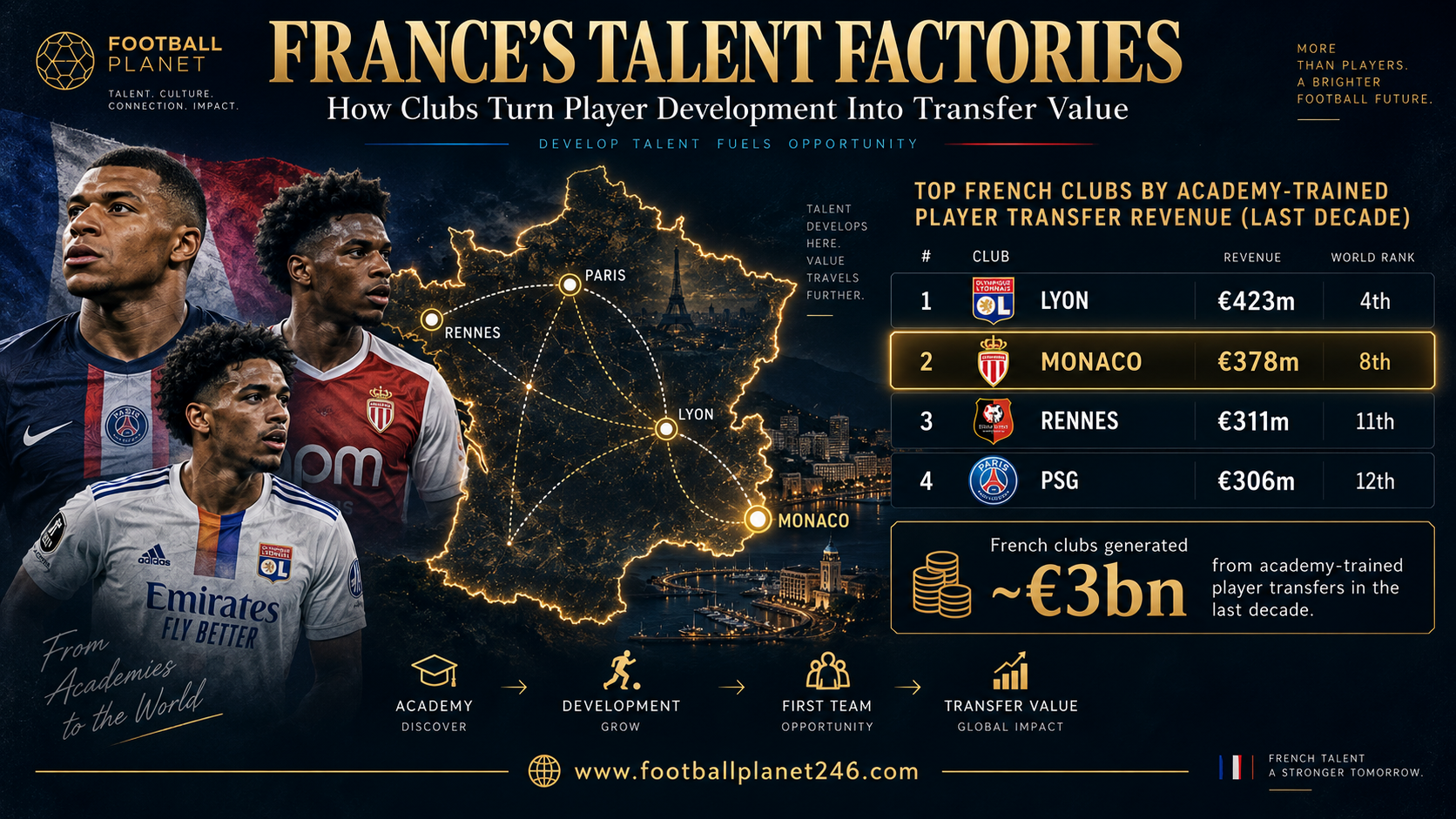
France Is More Than a Talent Market
France has long been recognised as one of football’s most productive environments for developing players.
But the scale of that production becomes even more striking when development is measured not only through the number of professionals produced, but through the transfer value those players eventually generate.
According to the CIES Football Observatory, clubs in the French football system generated approximately €3 billion from transfers of academy-trained players over the last decade — the second-highest national total behind England. Twelve French clubs appeared among the world’s top 100 academy revenue generators.(Football Observatory)
That suggests something deeper than isolated success.
France has built an ecosystem capable of repeatedly identifying, developing and monetising elite-level talent.
Lyon: France’s Leading Academy Value Generator
Olympique Lyonnais stands at the top of the French ranking.
CIES calculated that Lyon generated approximately €423 million from transfers of academy-trained players over the ten-year period beginning in July 2016.
That placed the club fourth worldwide, behind only Benfica, Ajax and Chelsea. (Football Observatory)
The importance of Lyon is not simply the size of one transfer.
CIES recorded 31 academy-trained players contributing to that revenue total, with Alexandre Lacazette representing the largest individual share at 14%.
That distribution matters.
A sustainable development system should not depend entirely on producing one exceptional player.
It should repeatedly create footballers capable of entering the professional market.
Lyon’s numbers suggest exactly that.
Monaco: Development Embedded in the Club’s Identity
AS Monaco presents another particularly interesting model.
CIES ranked Monaco eighth worldwide, with approximately €378 million generated from academy-trained player transfers over the same decade. (Football Observatory)
Kylian Mbappé naturally represents a significant part of that figure — CIES estimates his contribution at 48% of Monaco’s academy transfer income in the period.
But reducing Monaco’s development history to one exceptional player would miss the broader picture.
The club celebrated the 50th anniversary of its Academy in April 2026. Since the training centre was established in the 1975–76 season, 147 Academy graduates have played at least one professional match for Monaco’s first team. The club also states that 91 players developed in the Principality have played in one of Europe’s Big Five leagues since July 2005. (AS Monaco)
That history gives Monaco a genuine development identity rather than simply a reputation built around transfer trading.
From La Diagonale to Wembley
There is another indication of how seriously Monaco treats its development methodology.
In May 2026, Academy director Sébastien Muet presented Monaco’s youth-development model at the Premier League Youth Development Conference at Wembley, where English clubs were introduced to La Diagonale, its philosophy, structure and objectives. (AS Monaco)
This is strategically important.
A strong academy is not only a collection of talented young players.
It is an organisational system.
Recruitment, coaching, education, competitive exposure, physical development and first-team integration all have to connect.
Monaco’s model appears designed around that continuity.
The club reported that Academy-developed players accounted for 18% of first-team playing time in 2025/26, the same proportion as the previous season. (AS Monaco)
Development therefore remains connected to the senior team rather than functioning only as a player-production department.
Rennes: A Modern Development Accelerator
Stade Rennais provides another powerful example.
CIES ranked Rennes 11th worldwide, with approximately €311 million generated through transfers of academy-trained players during the last decade.
Even more strikingly, €266 million — 86% of that total — was generated during the most recent five years covered by the study. (Football Observatory)
That suggests acceleration.
Rennes is not relying primarily on an older development legacy. Its recent player-development activity is producing significant market value now.
Désiré Doué represented the largest individual contribution in the CIES calculation, but once again the wider point is structural.
The club has developed an environment capable of moving young players from formation into high-value professional markets.
PSG: Elite Resources, Significant Academy Output
Paris Saint-Germain provides a different type of development case.
With approximately €306 million generated from academy-trained player transfers, PSG ranked 12th globally in the CIES study. (Football Observatory)
That matters because elite financial power and academy development are sometimes presented as opposites.
They do not have to be.
A club can simultaneously recruit established international players while developing footballers who create value elsewhere.
The strategic question is whether the pathway between academy and first team remains sufficiently open.
For recruitment professionals, that distinction is important: producing talented players and providing them with senior opportunity are related, but they are not the same thing.
Academy Value Is Not the Same as Transfer Profit
There is an important methodological distinction.
CIES defines a “training club” as the first club where a player spent at least three seasons between the ages of 15 and 21. The figures also include add-ons and sell-on income. (Football Observatory)
Therefore, these numbers should not be interpreted simply as accounting profit.
They measure something more specific:
the financial value generated through players developed within a club’s youth structure.
That makes the data particularly useful when analysing development ecosystems.
Development and Trading Can Reinforce Each Other
Monaco offers a useful contemporary example of how development philosophy and transfer strategy can coexist.
For the two transfer windows associated with the 2025/26 season, CIES calculated Monaco’s transfer balance at +€148 million — the most positive figure among clubs worldwide for that period. (Football Observatory)
That figure does not come exclusively from academy players and should not be presented as such.
But it illustrates the broader model.
A club capable of identifying talent early, developing players effectively and selling at the right moment can use the transfer market as a mechanism for reinvestment rather than simply expenditure.
Youth development and recruitment intelligence therefore become connected.
What Scouts and Clubs Can Learn From France
The French ecosystem offers several lessons.
The first is that development can create measurable economic value.
The second is that successful academies require repeated production rather than dependence on one generation.
The third is that first-team pathways remain critical. A player’s market value ultimately grows through competitive performance.
And the fourth is that clubs do not need identical models.
Lyon, Monaco, Rennes and PSG operate with different ownership structures, sporting ambitions and financial resources.
Yet all four sit close to the top of the global academy-value rankings. That suggests there is no single formula.
What matters is whether the pathway from identification → development → senior football → market value actually works.
France’s Competitive Advantage
The strongest football markets are not necessarily those that spend the most.
Some create their advantage by producing.
France — with Monaco included within the Ligue 1 ecosystem — continues to demonstrate an unusual ability to turn young footballers into professionals capable of competing at the highest levels and generating significant transfer value.
The numbers from Lyon, Monaco, Rennes and PSG are therefore not simply financial statistics.
They are evidence of development infrastructure. And for scouts, recruiters and clubs looking for sustainable models, that is the real lesson:
Talent creates opportunity. Development creates value. Systems create both repeatedly.