Beyond Performance: How Footballers Build Commercial Value
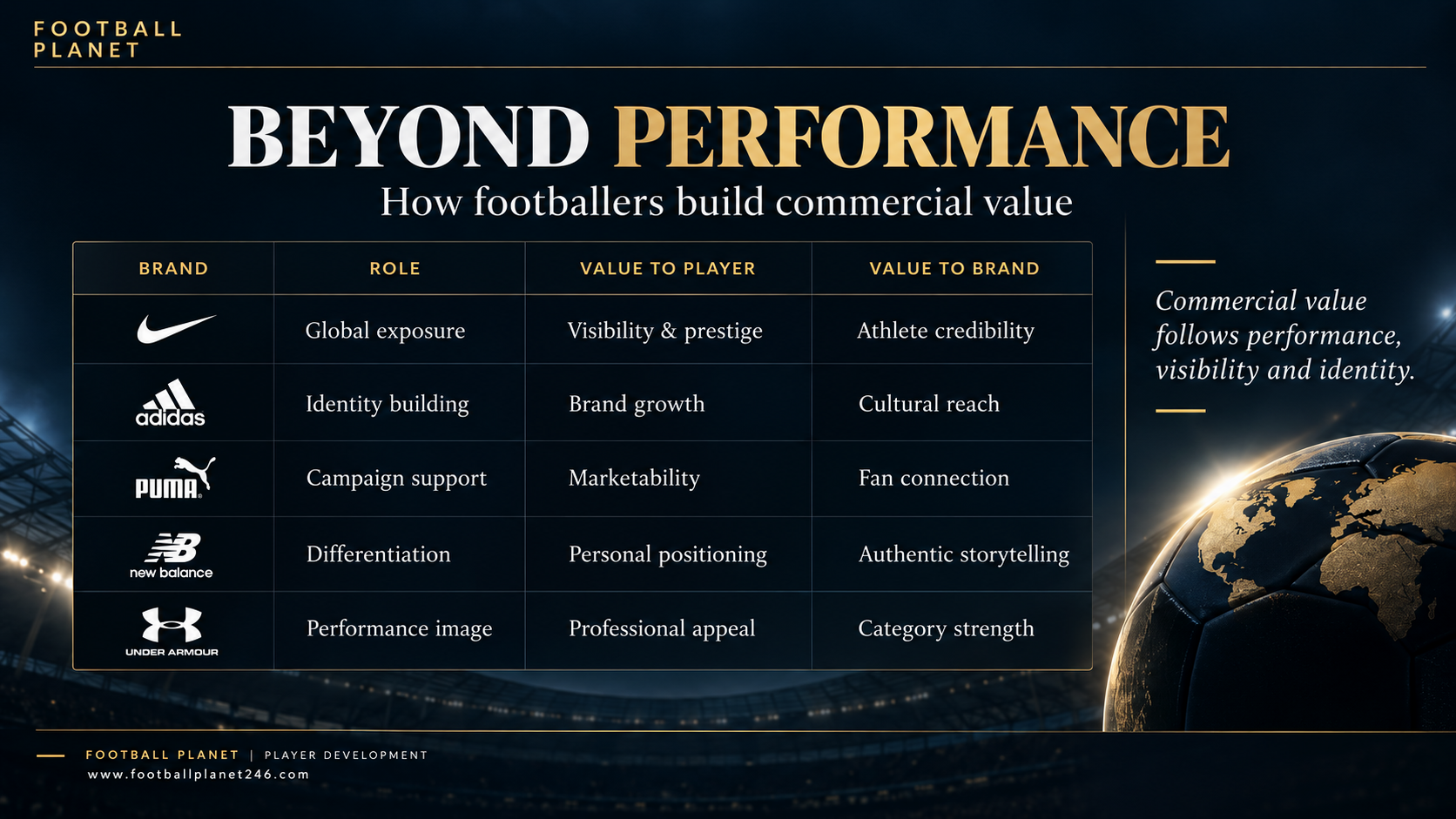
Player Development No Longer Ends on the Pitch
For decades, player development was primarily measured through technical ability, tactical understanding, physical progress and first-team minutes.
Those fundamentals remain essential.
But at the highest level of modern football, another dimension has become increasingly important: commercial value.
The most marketable players are no longer simply athletes. They can become global media properties, brand ambassadors and commercial platforms capable of reaching millions of supporters.
That does not mean marketing replaces performance. In most cases, performance creates the platform from which commercial value can grow.
The Numbers Behind Football’s Commercial Stars
Forbes estimates show how significant off-field income can become for football’s biggest names.
| Player | Estimated Off-Field Earnings | Examples of Commercial Partners |
| Lionel Messi | $70m | Adidas, Mastercard, Apple-related commercial arrangements |
| Cristiano Ronaldo | $65m | Nike, Binance, Perplexity |
| Kylian Mbappé | $25m | Nike, Hublot, Fairmont |
| Erling Haaland | $20m | Nike, Breitling, Dolce & Gabbana |
| Vinícius Jr. | $20m | Nike, Gatorade, Pepsi, Visa |
Figures are Forbes estimates covering sponsorships and other off-field commercial activities, not the value of one individual endorsement contract. (Forbes)
The scale matters. Forbes reported that the world’s 50 highest-paid athletes generated a record $1.1 billion in combined off-field earnings in its 2026 ranking. (Forbes)
Why Football Is So Attractive to Brands
Football offers companies something difficult to replicate: enormous global audiences combined with emotional loyalty.
Nielsen reported that 67% of global football fans find sponsoring brands more appealing, compared with 54% of the general population. Football also accounted for 41% of sports sponsorships in its analysis. (Nielsen)
This helps explain why brands compete not only for clubs and tournaments, but also for individual players.
A player can provide a brand with access to a specific generation, nationality, playing style or cultural identity.
The relationship can also work in the opposite direction.
How Brands Can Help Develop a Player’s Commercial Identity
The strongest partnerships go beyond placing a logo beside an athlete.
Adidas, for example, signed Lamine Yamal to a long-term partnership and subsequently developed personalised products around his identity, including the F50 “LY304”, referencing his Rocafonda roots. The company has also placed him alongside global figures such as Lionel Messi and Jude Bellingham in international campaigns. (Adidas News)
Nike similarly markets dedicated Erling Haaland products alongside its wider partnership with the Manchester City striker. (Nike.com)
These relationships can give players additional global exposure, storytelling opportunities and association with established international brands.
But the benefit is reciprocal.
The brand gains the player’s sporting credibility, audience, personality and connection with supporters.
Performance Still Comes First
Commercial development should not be confused with creating artificial popularity.
The strongest player brands are normally built on several foundations:
performance → visibility → identity → audience → commercial fit
A player who performs consistently, appears in major competitions and develops a recognisable identity becomes more attractive to sponsors.
Social media then gives that relationship another distribution channel.
Lamine Yamal is a striking recent example. Forbes reported that his social audience had grown to almost 77 million by late 2025, while his sponsorship portfolio expanded across sportswear, technology, beverages and financial brands. (Forbes)
The Football Planet Perspective
Player development should remain football-first.
Technical quality, decision-making, tactical intelligence, physical development and competitive minutes create the foundation.
But for players who reach higher levels, commercial positioning can become another component of long-term career value.
Clubs, agents, advisers and players increasingly need to understand both sides.
Develop the footballer.
Build the identity.
Protect the credibility.
Then create commercial value.