Europe’s Talent Factories: Which Clubs Create the Most Academy Transfer Value?
Development Is Not Just About Producing Players
In football, the strongest academies do more than produce talented youngsters.
They create systems.
Systems that identify talent early, develop it properly, expose it to the right competitive environments and eventually convert that process into first-team progression and transfer value.
That is why academy output should not be measured only by reputation or isolated success stories.
It should also be measured by repeatable sporting and economic outcomes.
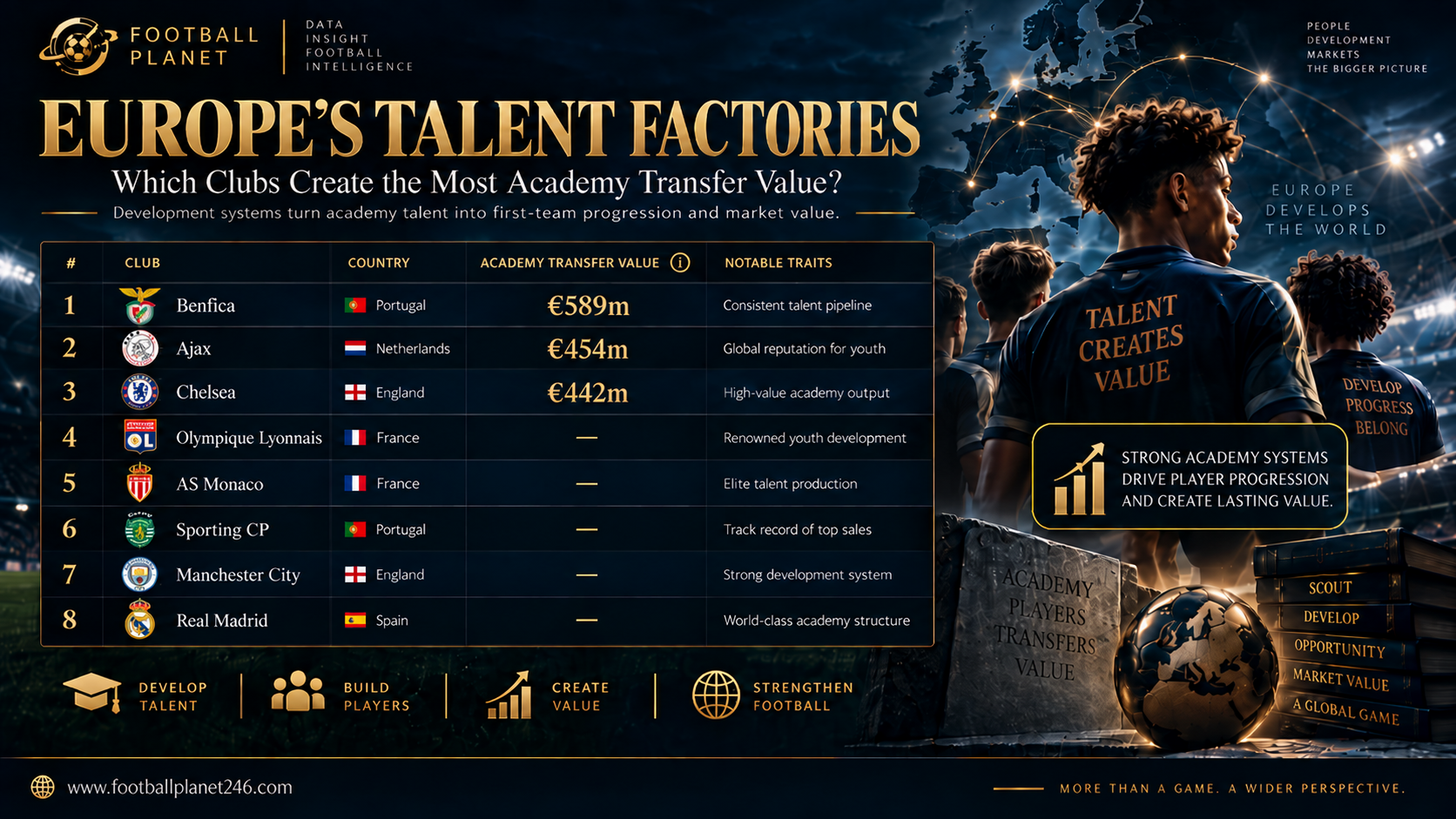
Recent analysis from the CIES Football Observatory offers one of the clearest ways to do that. Looking at income generated from transfers of academy-trained players over the last decade, Benfica leads with €589 million, followed by Ajax with €454 million and Chelsea with €442 million. (Football Observatory)
Those figures highlight an important point:
The clubs creating the most value are often those where development is embedded in the operating model rather than treated as a secondary function.
Benfica, Ajax and Chelsea at the Top
The three leading clubs are very different in identity, structure and football culture.
But they share an important characteristic:
They have built repeatable pathways from academy development to market value.
Benfica’s position reflects a model associated with early talent identification, competitive first-team exposure and transfers into wealthier football markets.
Ajax remains one of football’s most recognisable development institutions, where technical formation and pathway clarity are deeply connected to club identity.
Chelsea’s position is particularly interesting because it demonstrates that elite financial power and academy value creation are not mutually exclusive.
A major club can simultaneously recruit globally and produce significant economic value through players developed internally.
A Broader European Pattern
The wider ranking makes the picture even more interesting.
The CIES top 10 also includes Olympique Lyonnais, Monaco, Sporting CP, Manchester City, Real Madrid and Bayer Leverkusen, alongside Brazil’s Palmeiras. In total, clubs from 19 different national associations appear among the global top 100. (Football Observatory)
Two details are particularly relevant.
First, France places both Lyon and Monaco inside the global top 10, reinforcing the strength of the French player-development ecosystem.
Second, the ranking contains both traditional development-and-selling clubs and some of European football’s richest organisations.
Academy development is therefore no longer simply a financial necessity for smaller clubs. Increasingly, it is a strategic asset for elite clubs as well.
Why This Ranking Matters
There is a tendency in football to discuss player development in general terms.
Almost every club says its academy matters.
Almost every organisation talks about pathways.
Almost everyone claims to believe in young players.
Data helps distinguish communication from outcomes.
If a club repeatedly develops players who later generate significant transfer income, several parts of its football operation are probably working together effectively:
talent identification, coaching, progression planning, competitive exposure and decision-making around player value.
The ranking is therefore not simply about money.
It provides evidence about the effectiveness and repeatability of development systems.
Development Systems Create Strategic Value
Transfer value is rarely created by accident.
One exceptional player can emerge almost anywhere.
Producing valuable footballers repeatedly over many years requires something more durable.
It requires structure.
A functioning development model creates multiple possibilities.
One player may strengthen the first team.
Another may generate a transfer fee.
Another may develop elsewhere before producing sell-on income.
The strongest academies therefore create more than footballers.
They create assets, options and strategic flexibility.
For sporting directors and recruitment departments, that is an important distinction.
The Methodology Matters
The CIES methodology defines a training club as the first club where a player spent at least three seasons between the ages of 15 and 21.
The figures also include add-ons and income from sell-on clauses. (Football Observatory)
This distinction matters because the ranking is not simply measuring transfer-market activity.
It is measuring financial value connected specifically to players developed within a club’s youth structure.
That makes it particularly useful when analysing academy effectiveness.
The Elite Clubs Are Changing Too
One of the most interesting findings appears when the timeframe is shortened.
Over the last five years alone, CIES reports that Chelsea generated €366 million from academy-trained player transfers, with Manchester City second at €318 million. (Football Observatory)
That suggests a broader change.
Youth development is increasingly important even inside clubs capable of spending heavily on established players.
Academies can provide squad depth, generate transfer revenue and create assets that strengthen a club’s wider sporting and financial model.
Development is therefore becoming part of a broader strategic approach.
What Clubs Can Learn
The strongest development organisations do not simply produce talent.
They build repeatable systems that move players through a sequence:
Identification → Development → Competitive Exposure → First-Team Value → Transfer Value
Benfica, Ajax, Chelsea, Lyon, Monaco and the other leading clubs have different philosophies and financial realities.
There is no single development formula.
But the strongest models share one fundamental characteristic:
They repeatedly convert potential into measurable outcomes.
The Bigger Football Planet Lesson
Academies should not be viewed only as youth departments.
At their best, they become part of the club’s sporting and economic infrastructure.
They create players.
They create first-team options.
They create transfer value.
And they can create competitive advantages that last far longer than a single transfer window.
For clubs seeking sustainable growth, that may be the most important lesson of all.
Talent creates opportunity.
Systems turn that opportunity into value.