Europe’s Development Clubs: Where U21 Players Actually Get Minutes
Development Is Measured in Minutes
Youth development is one of the most frequently used phrases in modern football.
Almost every club speaks about pathways, academies and giving young players opportunities.
But there is a simple question that cuts through the language:
Do young players actually play?
First-team minutes remain one of the clearest indicators of whether a club truly trusts young talent in competitive environments.
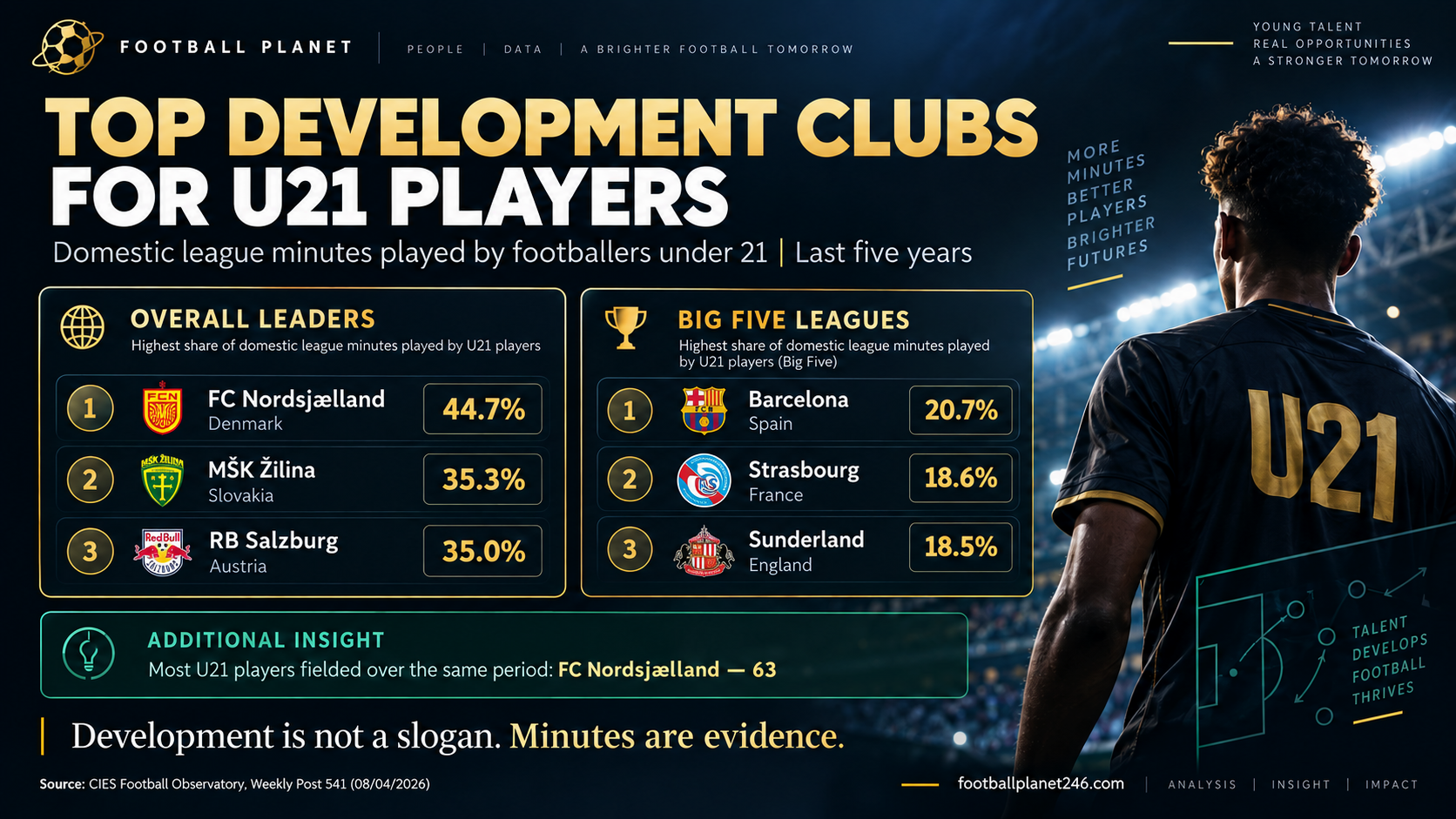
Recent data from the CIES Football Observatory provides a useful benchmark. Looking at domestic league matches over the last five years, FC Nordsjælland recorded the highest percentage of minutes played by footballers who had not yet turned 21: 44.7%. MŠK Žilina followed with 35.3%, while RB Salzburg ranked third at 35.0%. (Football Observatory)
These figures do more than identify young squads.
They help reveal clubs where youth development is embedded in the competitive model.
FC Nordsjælland: Development as a System
FC Nordsjælland stands apart.
Over the five-year period analysed by CIES, almost half of the club’s domestic league minutes were played by U21 footballers.
The Danish club also fielded 63 different U21 players, the highest total among the 50 leagues studied. (Football Observatory)
That matters.
A development club should not be defined by one exceptional generation or one group of academy graduates.
The stronger evidence is repetition.
If young players continue to enter the first team across multiple seasons, development becomes part of the operating model rather than a temporary circumstance.
Nordsjælland’s connection with the Right to Dream academy in Ghana adds another dimension. The club combines locally trained players, young international recruitment and early first-team exposure within one development pathway. In September 2026, CIES again ranked Nordsjælland first for U21 usage in domestic league matches during the calendar year, with 48.1% of minutes. (Football Observatory)
The pattern therefore appears structural rather than accidental.
Žilina and Salzburg: Two Different Development Environments
MŠK Žilina’s position is equally significant.
With 35.3% of domestic league minutes given to U21 players over the five-year period, the Slovak club ranked second globally in the CIES analysis. Žilina fielded 51 U21 players during that period. (Football Observatory)
Slovakia more broadly also presents an interesting development environment.
Three Niké liga clubs appeared inside the top six of the CIES five-year ranking: Žilina, AS Trenčín and FK Železiarne Podbrezová. (Niké liga)
RB Salzburg represents a different model.
The Austrian club combines aggressive recruitment of young talent with a competitive environment designed to accelerate players towards higher levels.
Its 35.0% U21 share over five years reinforces something already visible through its recruitment history: Salzburg does not simply acquire young players.
It gives them meaningful competitive responsibility. (Football Observatory)
What the Big Five Tell Us
The same comparison becomes more difficult inside Europe’s largest leagues.
Financial pressure is higher.
Squads are deeper.
The immediate cost of dropping points can be enormous.
That makes regular U21 exposure particularly significant.
Among clubs currently competing in Europe’s Big Five leagues, Barcelona led the five-year CIES ranking with 20.7% of league minutes going to U21 players.
RC Strasbourg followed at 18.6%, with Sunderland at 18.5%. (Football Observatory)
The percentages are lower than those seen at Nordsjælland, Žilina or Salzburg, but the competitive context is very different.
What matters is not simply comparing the raw numbers.
It is understanding what those numbers mean inside each football environment.
Playing Time Changes the Development Equation
For a young player, signing for a prestigious club does not automatically mean joining a strong development environment.
Training quality matters.
Coaching matters.
Facilities matter.
Competition level matters.
But development also depends on exposure to real decisions, real pressure and real consequences.
A player who trains with experienced professionals but rarely enters competitive matches follows a very different pathway from a player trusted with 1,500 or 2,000 senior minutes.
That distinction is critical in recruitment.
When evaluating a potential move, the question should not only be: How strong is the club?
It should also be:
How realistic is the pathway to meaningful minutes?
Development Club Does Not Mean Easy Club
High U21 usage should not be misunderstood.
A development club is not necessarily an easier destination for young players.
Often the opposite is true.
Clubs built around youth development usually recruit aggressively, maintain strong internal competition and expect young players to adapt quickly.
Opportunities may exist.
But they are rarely guaranteed.
This is why historical playing-time data should be used as evidence of club behaviour, not as a promise of future minutes.
A club that repeatedly trusts U21 players has demonstrated an organisational willingness to use young talent.
The individual player still has to earn the opportunity.
What Scouts and Players Should Look For
The strongest development environments usually reveal several recurring characteristics.
They recruit players before peak market value.
They create genuine first-team pathways.
They accept a degree of short-term performance volatility.
They develop players inside competitive matches rather than exclusively in training.
And they frequently connect development with future transfer value.
For scouts, agents and players, this changes how clubs should be assessed.
Reputation alone is not enough.
Academy branding is not enough.
Statements about “believing in youth” are not enough.
Minutes provide evidence.
The Bigger Recruitment Lesson
The CIES ranking highlights an important distinction between clubs that possess young players and clubs that actually use them.
That distinction matters across the recruitment market.
Young players need environments where development is not simply part of the club’s communication strategy, but part of its sporting structure.
FC Nordsjælland, MŠK Žilina and RB Salzburg operate in different leagues, with different resources and different competitive pressures. Yet they share one measurable characteristic:
young players are trusted with meaningful senior football.
That may be one of the most important indicators when assessing a genuine development pathway.
Development is not a slogan. Minutes are evidence.