Domenico Fracchiolla: Building Sustainable Football Through Scouting, Strategy and Youth Development

A Career Built Around Talent Development and Football Management
Building a competitive football club is not simply a question of identifying talented players. It requires financial discipline, a clear sporting strategy and the ability to recognise opportunities that fit the club's long-term objectives.
Few environments illustrate these challenges more clearly than Italy's Serie B and Serie C, where sporting ambition must often operate within significant financial constraints.
Domenico Fracchiolla, an Italian sporting executive and former Sporting Director of Reggiana, brings experience across different levels of Italian professional football, with a background rooted in scouting, youth development and sporting management.
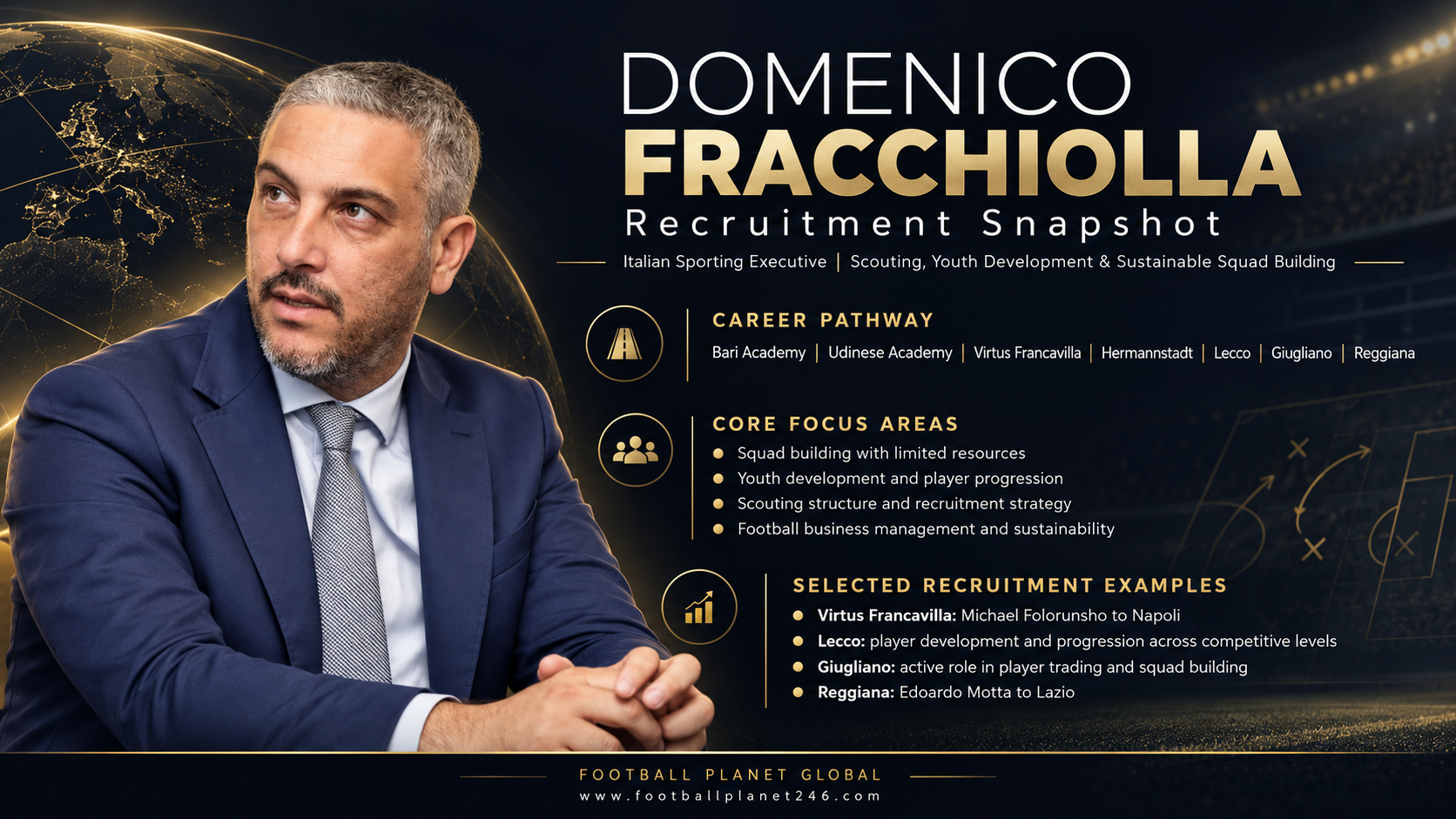
Born in 1984 in the Puglia region, Fracchiolla holds a degree in Law and began his football career in youth development, working with Pro Inter Bari and Wonderful Bari before progressing to positions at Bari and Udinese.
His professional journey subsequently included Virtus Francavilla, Romanian club Hermannstadt, Lecco, Giugliano and Reggiana, where he served as Sporting Director during the 2025–26 season (Italian Serie B).
His experience also extends beyond club management into professional education, including teaching activities with Sport Business Academy and contributions to university-level lectures in Italy.
Throughout his career, Fracchiolla has worked in environments where identifying talent, managing resources and building competitive squads represent interconnected responsibilities.
1. Building Competitive Squads with Limited Resources
Football Planet Global: Based on your experience as a Sporting Director across Italian football, what are the most important factors when building a competitive squad with limited financial resources?
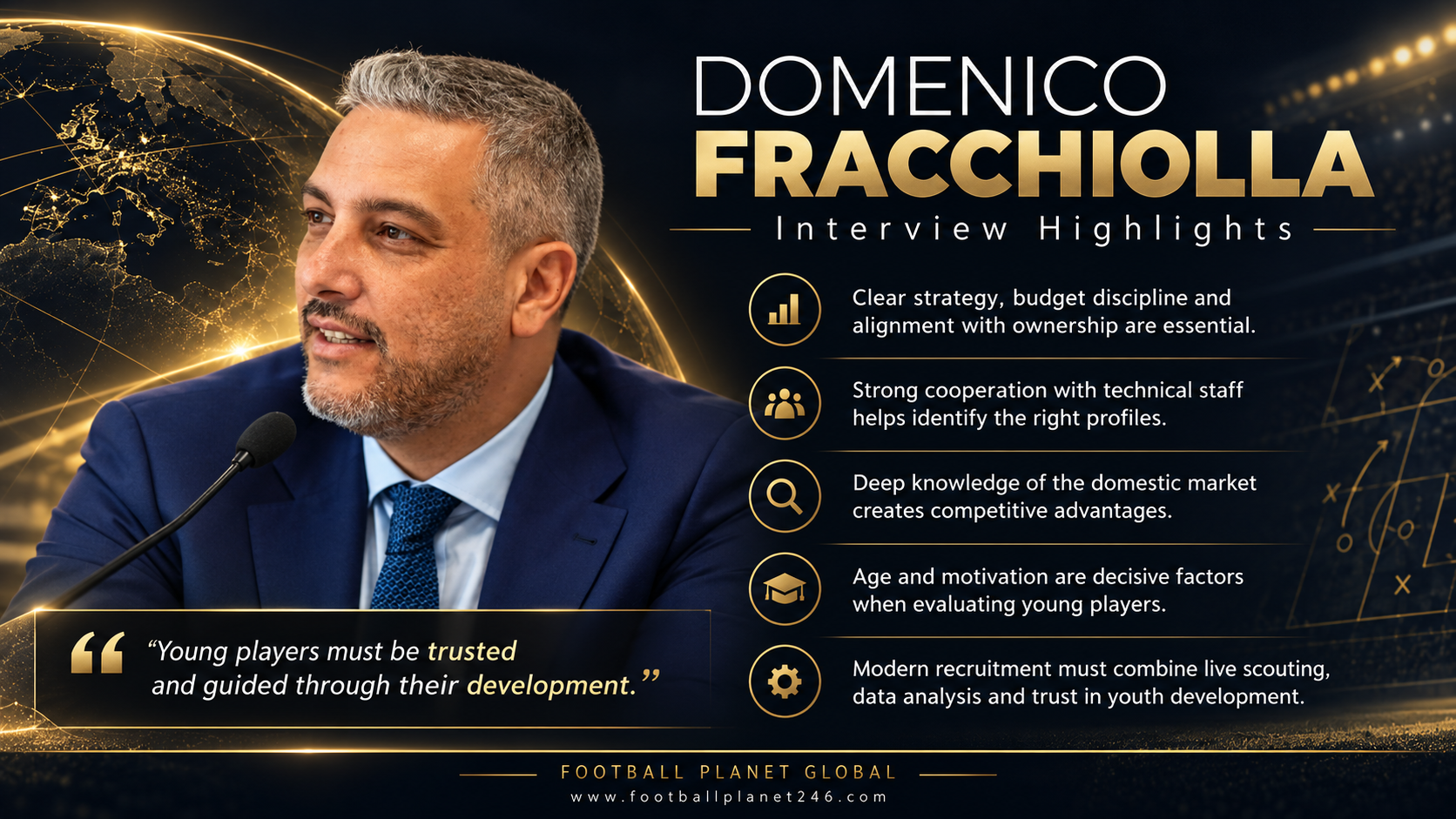
Domenico Fracchiolla: A transfer market is a long process, and its dynamics shift frequently. Therefore, it is essential to plan a clear strategy with the club's ownership, establish specific aims and a well-defined budget, and maintain a strong relationship with the technical staff to identify the most appropriate profiles. With a limited budget, one must have a deep knowledge of the domestic market—in my case, the Italian market—to seize the best opportunities. You also need to cultivate strong connections in various European countries that are home to players whose characteristics are well-suited to the league in which we operate.
2. Looking Beyond Technical and Physical Ability
Football Planet Global: When evaluating a young player, which qualities do you consider most important beyond technical ability, statistics and physical performance?
Domenico Fracchiolla: The interplay between physical attributes, technical skills, and other related data already provides a significant insight into a player. However, I believe that beyond these objectively observable qualities, the combination of a player's age and their level of motivation at that specific moment is what truly makes the difference.
3. Connecting Traditional Scouting with Data Analysis
Football Planet Global: How should a modern Sporting Director combine traditional scouting, data analysis and direct observation when making recruitment decisions?
Domenico Fracchiolla: For clubs that aim to plan ahead and stay organized, there must be a precise and clear working relationship between the sporting director and the head of scouting. In my view, everything should begin with a well-structured organization that analyzes every aspect of a player, always keeping the club’s broader objectives in mind. Combining live, in-stadium observation with data analysis—tailored to our specific context and the league in which we compete—is what makes modern scouting so fascinating and engaging.
4. Balancing Immediate Results and Long-Term Player Value
Football Planet Global: How can clubs balance the pressure for immediate sporting results with the long-term development and potential transfer value of young players?
Domenico Fracchiolla: The club’s identity and its strength in maintaining the strategy established with management at the beginning of every season are fundamental. Where this is lacking—which happens often in Italy—many talents fail to reach and show their full potential and are ultimately lost.
5. Opportunities and Challenges for Smaller Italian Clubs
Football Planet Global: Looking at the evolution of Italian football, what opportunities and challenges do you see for smaller professional clubs seeking to develop talent and compete sustainably?
Domenico Fracchiolla: In Italy, given the national regulations and the way financial resources are distributed in Serie B and Serie C leagues—which is largely based on "actual playing time" (rewarding clubs that field young Italian players)—it is essential to maintain a consistent focus on youth academies and on young Italian talents. Club executives must not be afraid to give these players their debut and place trust in them; for me, this comes naturally, as my own career as a sporting director began in youth development. To ensure young players become a true asset to the club, they must be guided throughout their development and supported when they face difficulties.
The Football Planet Perspective
Several important themes emerge from Fracchiolla's answers.
The first is that effective recruitment begins long before the transfer window opens. Ownership, sporting directors, scouting departments and coaching staff must share a consistent understanding of the club's objectives.
The second is that player evaluation should extend beyond measurable qualities. Motivation, developmental context and individual circumstances remain important considerations when assessing young footballers.
Perhaps most importantly, his observations highlight the connection between organisational stability and sustainable talent development.
For smaller professional clubs, investing in young players is not simply a sporting ambition. It can be part of a broader strategy to create long-term competitive and economic value.
Talent identification creates opportunities. Organisational consistency determines whether clubs can develop and realise that potential.
About Domenico Fracchiolla
Domenico Fracchiolla is an Italian sporting executive with a Law degree and professional experience in youth development, scouting, sporting direction and club management.
His career includes positions at Bari, Udinese, Virtus Francavilla, Hermannstadt, Lecco, Giugliano and Reggiana. Beyond his club responsibilities, he has contributed to professional education and academic lectures focused on sport and football management.
This interview was conducted in writing for Football Planet Global. The responses are reproduced as supplied by Domenico Fracchiolla. Editorial introductions, headings and concluding analysis were prepared by Football Planet Global.