World’s Best U21 Talents Outside Europe’s Big Five
Elite Talent Is Not Confined to the Big Five
When football talks about elite young talent, attention naturally gravitates toward the Premier League, LaLiga, Serie A, Bundesliga and Ligue 1.
But some of the world’s most productive U21 players are developing outside those competitions.
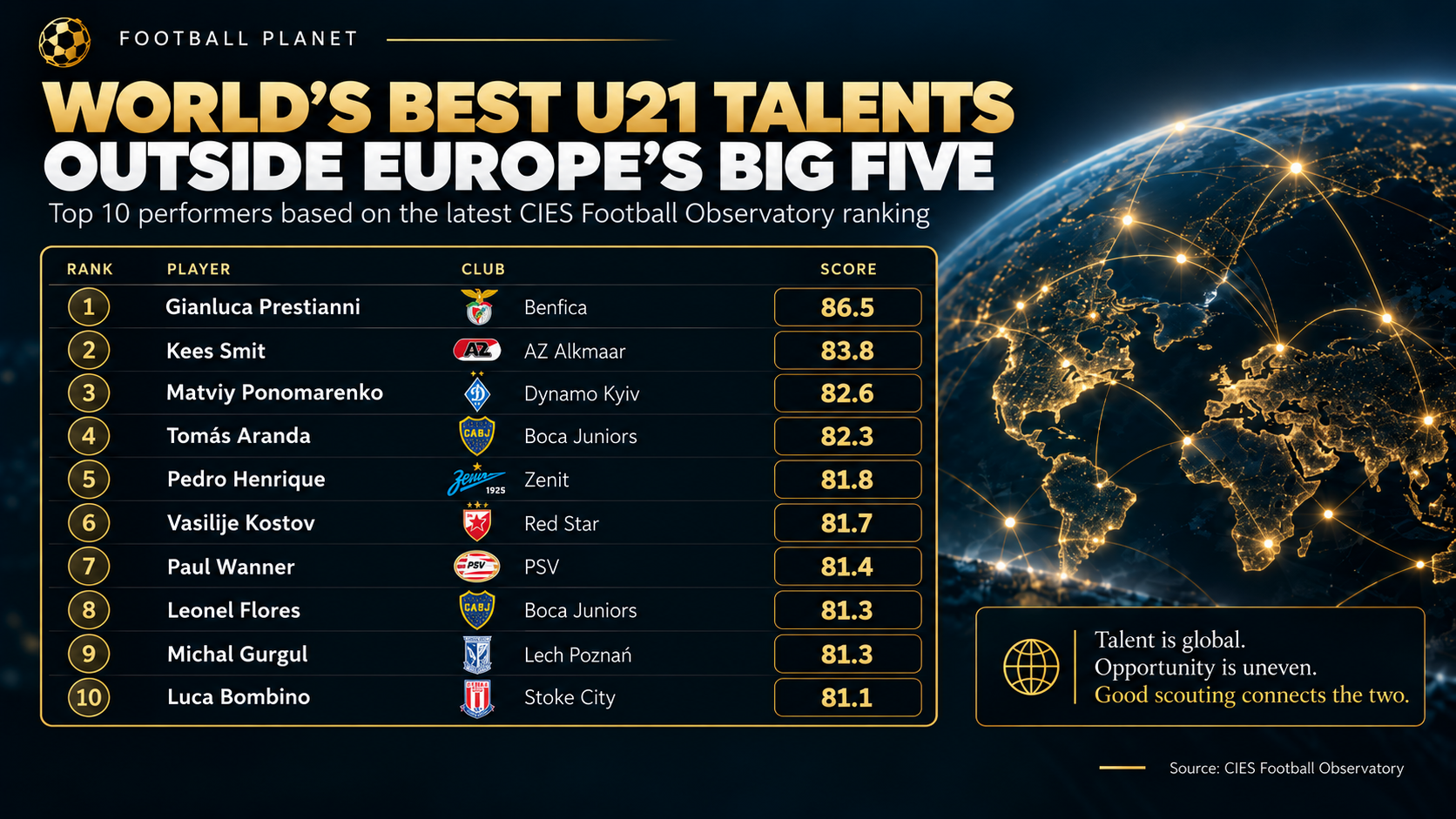
The latest CIES Football Observatory ranking highlights the best-performing U21 players outside Europe’s Big Five leagues over the last year, using a performance score based on multiple areas of play, minutes played and the competitive level of matches. (Football Observatory)
The result is a useful reminder for recruitment departments:
high-level young talent is distributed far beyond football’s most visible markets.
The Leading U21 Performers
According to the CIES ranking, Benfica’s Gianluca Prestianni leads the list with a performance score of 86.5/100. (Football Observatory)
Behind him, the leading group includes players from the Netherlands, Ukraine, Argentina, Russia, Serbia, Poland and England.
| Rank | Player | Club | Performance Score |
| 1 | Gianluca Prestianni | Benfica | 86.5 |
| 2 | Kees Smit | AZ Alkmaar | 83.8 |
| 3 | Matviy Ponomarenko | Dynamo Kyiv | 82.6 |
| 4 | Tomás Aranda | Boca Juniors | 82.3 |
| 5 | Pedro Henrique | Zenit | 81.8 |
| 6 | Vasilije Kostov | Red Star | 81.7 |
| 7 | Paul Wanner | PSV | 81.4 |
| 8 | Leonel Flores | Boca Juniors | 81.3 |
| 9 | Michal Gurgul | Lech Poznań | 81.3 |
| 10 | Luca Bombino | Stoke City | 81.1 |
The ranking underlines how broad the modern talent landscape has become.
Why This Matters for Recruitment
For scouting departments, the most important lesson is not simply who ranks first.
It is where these players are developing.
Benfica, AZ Alkmaar, PSV and Red Star have long been associated with youth development, but this list also highlights the importance of markets such as Argentina, Poland, Ukraine and other non-Big Five environments.
These competitions can offer young players something that is often difficult to obtain at major clubs:
meaningful minutes, responsibility and competitive exposure.
That experience can accelerate development and increase transfer relevance.
Performance Before Reputation
One of the strengths of this type of ranking is that it shifts attention away from reputation alone.
A highly publicised academy player is not automatically more advanced than a player competing regularly in a less visible league.
For recruitment teams, the key questions remain:
How much is the player actually playing?
At what competitive level?
What responsibilities does he have?
And how consistently is he performing?
Data can help identify candidates, but context remains essential.
A Wider Global Talent Market
The ranking also reflects a broader structural change.
Clubs increasingly scout globally at younger ages, while data platforms make it easier to compare players across competitions.
The traditional hierarchy of football markets still matters, but it no longer defines where valuable talent can emerge.
A player developing in Portugal, Serbia, Argentina, Poland or Ukraine can enter the international recruitment conversation much earlier than in previous generations.
That increases competition for talent — but also creates opportunity for clubs willing to search beyond the obvious leagues.
The Football Planet Perspective
For Football Planet, the key takeaway is simple:
the best recruitment strategies do not begin with the biggest leagues. They begin with the right evidence.
Performance data can help narrow the search.
Scouting provides context.
Development environments explain why certain players progress faster than others.
And transfer timing determines whether value can still be captured.
The strongest recruitment departments understand all four.
Talent is global.
Opportunity is uneven.
Good scouting connects the two.
Source: CIES Football Observatory – Weekly Post 553
World’s best U21s outside the Big Five: last year performance (Football Observatory)