The World’s Most Expensive Squads: Where Football’s Biggest Investments Sit
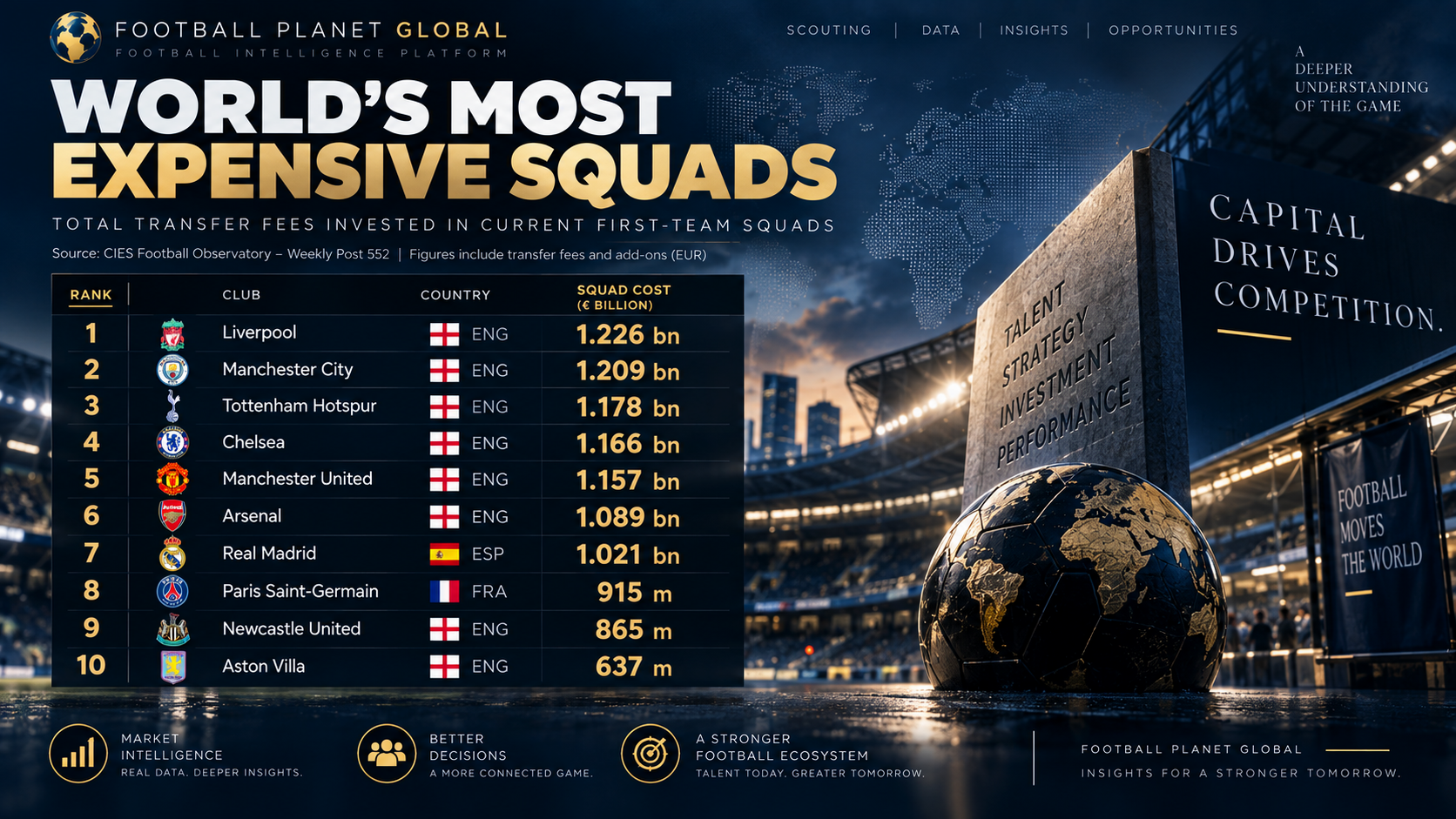
Modern football is increasingly shaped by capital.
At the top end of the game, success is not only built through coaching, talent identification and player development. It is also built through investment — and one of the clearest ways to see that investment is by looking at the cost of a club’s current squad.
Recent analysis from the CIES Football Observatory offers a strong snapshot of where football’s biggest financial commitments sit today. Liverpool lead the ranking for the most expensive squad in world football, with more than €1.2 billion invested in transfer fees. Even more striking, the first six places are occupied by Premier League clubs, underlining the extraordinary financial concentration within English football.
That matters.
Squad cost is not a perfect measure of quality, but it is a powerful indicator of market power. It shows which clubs have the financial capacity to repeatedly buy high-level talent, absorb risk and refresh their teams with established players from strong leagues.
In simple terms, expensive squads usually reflect three things working together:
1. Financial strength
Clubs with greater revenues, stronger ownership backing or deeper commercial ecosystems can spend more aggressively in the transfer market.
2. Recruitment ambition
High squad cost often signals a strategy built around acquiring ready-made talent rather than relying primarily on academy output or low-cost market opportunities.
3. Competitive pressure
At elite clubs, the margin for error is small. The need to compete immediately in domestic and European competitions pushes decision-makers toward costly acquisitions.
But this is where the conversation becomes more interesting.
High spending and smart spending are not the same thing.
A club can build an expensive squad and still recruit inefficiently. It can spend heavily on players who do not fit the tactical model, duplicate existing profiles or fail to create long-term value. In contrast, another club may spend less overall but operate with greater precision — targeting the right age profiles, the right tactical traits and the right resale potential.
That is why squad cost should not be viewed as a trophy in itself.
It is a signal of investment, not proof of efficiency.
This distinction is particularly relevant in the Premier League. The financial strength of English clubs has created a landscape in which spending power is unmatched, but the real competitive edge still comes from decision quality. Recruitment departments, sporting directors and ownership groups do not gain an advantage simply by paying more. They gain it by allocating resources better than rivals.
The presence of Real Madrid as the top-ranked non-English club also highlights an important contrast. While English football dominates the upper end of the spending table, elite clubs outside England still remain competitive through a combination of brand power, sporting prestige, selective investment and strong squad planning.
For clubs operating below that financial tier, this kind of data is equally valuable.
Why?
Because it helps clarify the broader market structure. It shows where elite-level capital is concentrated, which clubs can outspend almost everyone else, and how difficult it is for smaller or mid-level organisations to compete directly in the same talent markets.
That reality forces many clubs into a different path.
Instead of trying to win through pure spending, they must win through:
- sharper scouting,
- earlier identification of undervalued talent,
- better player development,
- and clearer recruitment logic.
In that sense, the most expensive squads tell two stories at the same time.
The first is obvious: football’s biggest brands continue to command the game’s largest financial resources.
The second is more strategic: the clubs outside that group must become smarter, faster and more disciplined if they want to compete sustainably.
This is why squad cost is such a useful football intelligence topic.
It is not just about money.
It is about structure.
It is about competitive reality.
And it is about the relationship between investment and decision-making.
The clubs at the top of this ranking have bought extraordinary depth and quality. But over time, the most important question is not who spends the most.
It is who turns investment into performance most effectively.
Because in modern football, capital can build a squad.
Only strong recruitment can turn it into a winning model.
*The 552nd Weekly Post from the CIES Football Observatory published this week ranks the teams around the world that have spent the most on transfer fees (bonuses included regardless of whether they were actually paid) to recruit the players in their current squad.