Who Owns European Football? The Rise of Multi-Club Networks
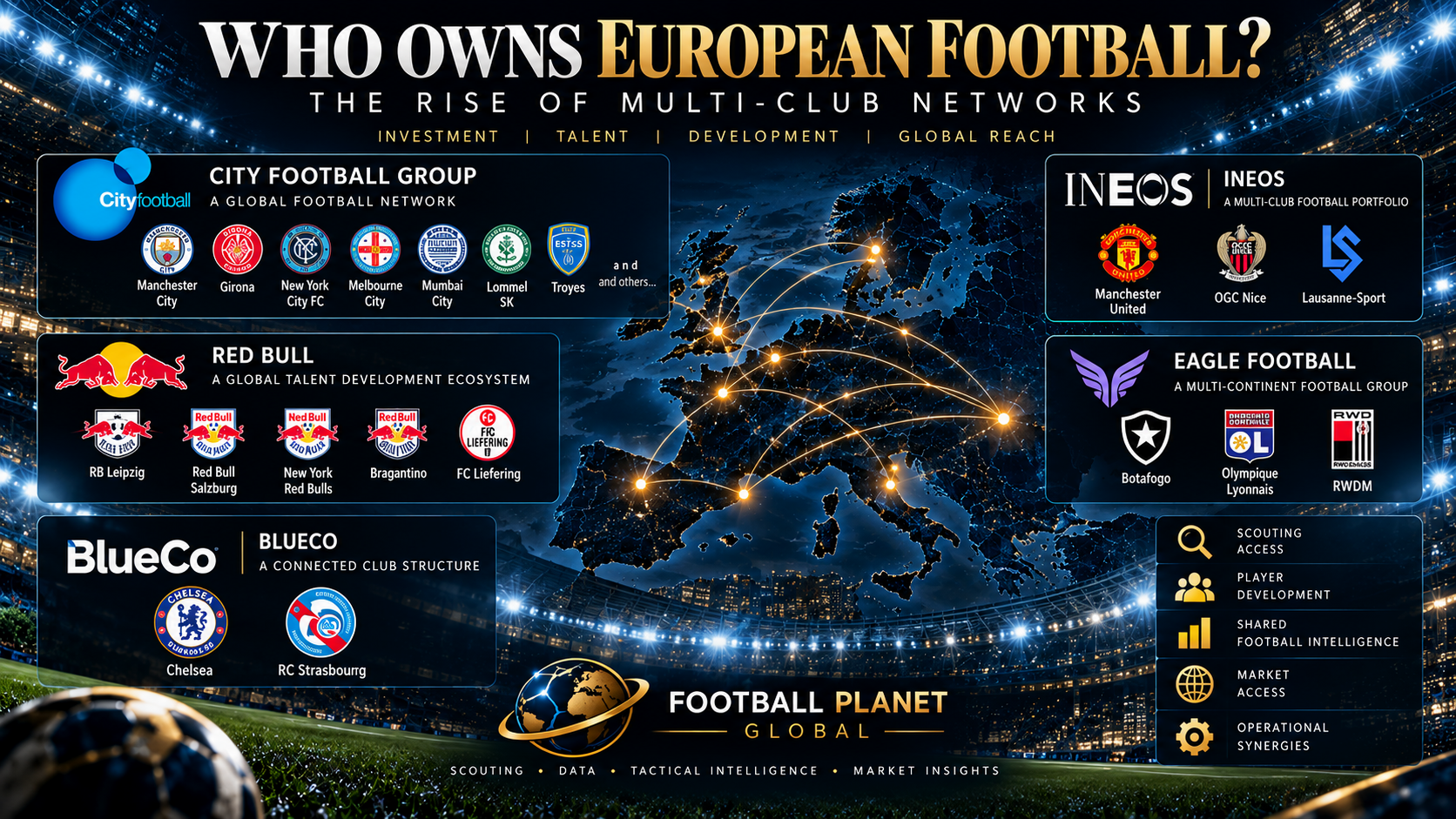
European football ownership is evolving.
For decades, the traditional model was relatively simple: an investor acquired a club and attempted to grow that individual asset.
Today, an increasing number of football organisations operate across networks of clubs, creating structures that can connect recruitment, player development, data, commercial strategy and access to different markets.
The result is the rise of the multi-club model.
From One Club to a Football Network
Perhaps the clearest example is City Football Group.
What began with Manchester City has developed into an international football organisation spanning multiple clubs and markets. The strategic logic goes beyond ownership itself. A network can potentially create shared knowledge, international scouting coverage, player pathways and commercial opportunities across several football environments.
The model reflects a wider shift in how investors view football: not only as individual clubs, but as interconnected platforms.
Different Models, Similar Strategic Questions
Not every multi-club structure operates in the same way.
INEOS, for example, has football interests connected with Manchester United, OGC Nice and Lausanne-Sport. Its involvement illustrates how one investment group can hold different forms of ownership or sporting influence across multiple organisations.
The Chelsea–Strasbourg relationship provides another high-profile case.
Since Strasbourg entered the same ownership ecosystem as Chelsea, player movement between the two clubs has become increasingly visible. The structure offers an example of how clubs in different leagues can potentially provide different stages of development, competitive exposure and squad planning.
Across the wider market, groups such as Red Bull have also demonstrated how a common football philosophy can be applied across different countries while identifying and developing young talent.
Why Build a Multi-Club Network?
The attraction is understandable.
A multi-club structure can potentially provide:
Broader scouting access — recruitment departments can monitor multiple markets and talent pools.
Player development pathways — younger players may find competitive environments suited to different stages of their development.
Shared football intelligence — data, analysis and recruitment methodologies can potentially be used across the network.
Market access — operating in different countries gives groups exposure to different leagues, player markets and commercial environments.
But the model also creates significant questions.
The Competitive Integrity Challenge The closer football clubs become operationally connected, the more important governance becomes.
UEFA regulations restrict situations where the same person or entity can exercise control or decisive influence over multiple clubs participating in the same European competition. That makes ownership structures, board independence and sporting decision-making increasingly important as multi-club groups expand.
The tension is clear.
The same integration that can create efficiencies in scouting, recruitment and development may also create concerns over competitive independence.
The Football Planet Perspective
Multi-club ownership is not simply another investment trend.
It represents a different way of organising football assets.
For investors, the question is increasingly moving from:
“Which club should we buy?”
to:
“How can several clubs operate within one wider football strategy?”
For football itself, however, the long-term challenge will be balancing the potential advantages of these networks with the independence and competitive integrity that make individual clubs meaningful.
The ownership map is changing.
And increasingly, the most important asset may not be one club — but the network connecting several of them.