Is Uzbekistan Becoming One of Asia’s Most Important Emerging Talent Markets?
Introduction
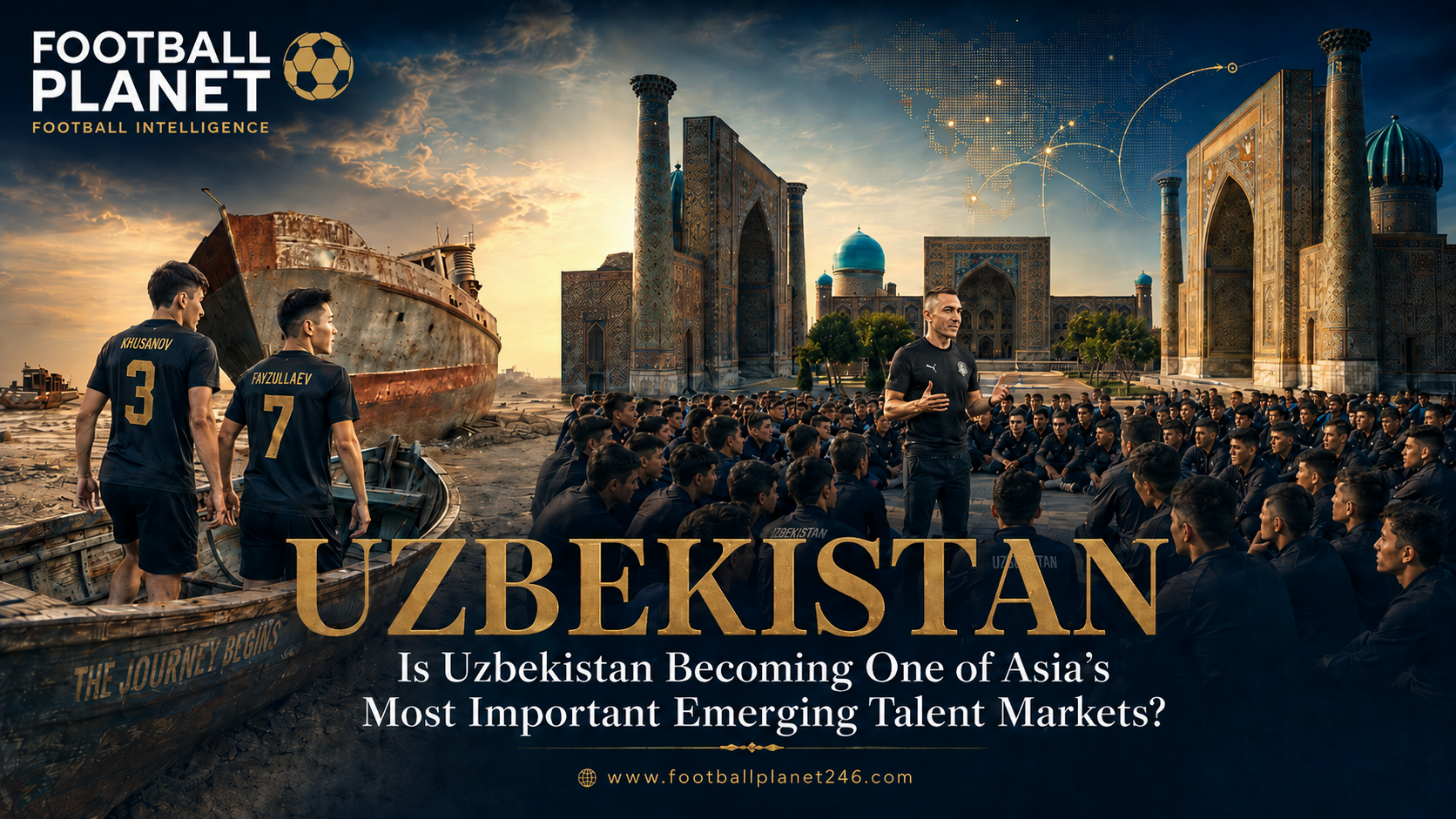
For many years, Uzbekistan remained largely outside the regular recruitment radar of major European football markets. That perception is beginning to change. The emergence of players such as Abdukodir Khusanov, now at Manchester City, and Abbosbek Fayzullaev, who moved from Pakhtakor to CSKA Moscow before joining İstanbul Başakşehir, has given Uzbek football greater international visibility. But individual success stories tell only part of the story. Behind them sits a wider development picture: stronger youth structures, significant results at Asian youth level, increased international exposure and, ultimately, Uzbekistan’s first qualification for the FIFA World Cup. The question is therefore becoming increasingly relevant: Are we witnessing isolated examples — or the emergence of a sustainable talent market?
Youth Success Is Becoming Difficult to Ignore
One of the strongest indicators comes from Uzbekistan’s youth national teams. Uzbekistan won its first AFC U20 Asian Cup in 2023, defeating Iraq in the final. The success placed the country among a small group of Asian nations to have won continental titles at U17, U20 and U23 level. (The AFC) Two years later, Uzbekistan also won the 2025 AFC U17 Asian Cup, defeating Saudi Arabia 2–0 in the final despite finishing the match with nine players. (The AFC) Results alone do not prove that a complete development system exists. However, when success appears across several age groups and different generations, it becomes increasingly difficult to treat it as coincidence.
Building a More Structured Domestic Pathway
The development story goes deeper than tournament results. Since 2020, the Uzbekistan Professional Football League has operated a national U19 Championship involving youth teams from Super League and Pro League clubs. According to the league, approximately 800 players aged 15–19 participate in the competition. (PFL.UZ) The Uzbekistan Football Association has also maintained three-star status within the AFC Elite Youth Scheme, with the AFC specifically highlighting the strength of the country’s youth development programmes. (The AFC) This is important from a recruitment perspective. Talent becomes easier to identify when players are competing regularly inside organised environments, progressing through recognised competitions and gaining exposure through national youth teams. The infrastructure does not need to resemble Western Europe to become productive. It needs to create enough structure for talent to be discovered, tested and progressively moved toward higher levels.
Abdukodir Khusanov — The Breakthrough Case
Khusanov represents perhaps the clearest evidence that an Uzbek pathway can now reach football’s highest levels. Developed initially in Tashkent, his career accelerated outside Uzbekistan before taking him through Belarus and France to Manchester City. Manchester City signed him from Lens in January 2025, making him the first Uzbek player to appear in the Premier League. (Manchester City FC) His pathway matters almost as much as his destination. Uzbekistan did not need to move a player directly from its domestic league into one of Europe’s biggest clubs. Instead, Khusanov progressed through intermediate environments where his level could be tested, validated and eventually recognised by a much larger market. For emerging football nations, that type of pathway can be particularly important.
Abbosbek Fayzullaev — A Different European Route
Fayzullaev followed another route. After developing at Pakhtakor, he moved to CSKA Moscow before İstanbul Başakşehir signed him on a five-year contract in July 2025. (ibfk.com.tr) His progression illustrates another important characteristic of developing markets: the destination does not always need to be one of Europe’s traditional top-five leagues. Russia and Türkiye can function as intermediate markets where a talented player gains experience, exposure and greater transfer visibility. For recruitment departments, this raises an interesting question: Is the optimal time to identify Uzbek talent before these players enter the more expensive secondary European market?
The Value of Intermediate Markets
This may become one of the most important aspects of Uzbekistan’s future recruitment relevance. Emerging talents rarely move through identical pathways. Some may reach Eastern Europe. Others may move through Türkiye, Belgium, France or other development-oriented markets. What matters is whether clubs can identify players before the wider market fully adjusts to their potential. Khusanov and Fayzullaev demonstrate two different routes, but both reinforce the same principle: the earlier the market becomes internationally validated, the more expensive access to its best talent is likely to become.
From Youth Success to the World Cup
Uzbekistan’s progress has now reached senior international football. The country qualified for the FIFA World Cup for the first time, sealing its historic place at the 2026 tournament after an unbeaten run through the decisive stages of Asian qualification. (FIFA) That achievement provides another layer of validation. World Cup qualification does not automatically prove that a country has created an elite development model, but it does demonstrate that success at youth level is increasingly feeding into competitive senior football. That transition is critical. Many countries produce successful youth generations. Far fewer successfully convert them into a stronger senior national team.
Fabio Cannavaro and the Next Stage
Fabio Cannavaro’s appointment should therefore be understood as part of the next phase rather than the beginning of Uzbekistan’s development story. He took charge after the country had already secured its historic World Cup qualification. FIFA described Uzbekistan as possessing a technically gifted and ambitious squad, with Cannavaro bringing high-level international experience ahead of the tournament. (FIFA) The challenge now is different. Uzbekistan has already shown that talent exists. The next question is whether the federation and domestic football system can continue producing players capable of competing internationally — rather than relying on one exceptional generation.
Why Recruitment Departments Should Pay Attention
From a scouting perspective, Uzbekistan presents several interesting characteristics. The country has demonstrated success across multiple youth age groups, developed a more organised domestic competition structure and begun exporting players into increasingly important European environments. Most importantly, the market may still sit outside the regular scouting focus of many Western European clubs. That creates opportunity. Recruitment advantages are often strongest not when a market becomes fashionable, but during the period when evidence is accumulating and competition for talent remains relatively limited.
The Key Question: Is the Model Repeatable?
Khusanov is exceptional. Fayzullaev is another important example. But two successful players alone cannot define an entire football market. The real test will come from the next generation. Can Uzbekistan consistently produce players capable of moving into competitive European leagues? Can domestic clubs create development environments that prepare players technically, tactically and physically for international football? Can European recruitment networks identify these players earlier? And can the country convert youth success into a repeatable senior talent pipeline? Those questions will determine whether Uzbekistan becomes a genuine long-term recruitment market.
Final Thoughts — A Market Moving Onto the Radar
Uzbekistan should not yet be described as one of world football’s established talent factories. But the evidence is becoming increasingly difficult to dismiss. Youth continental titles, organised development structures, World Cup qualification and the emergence of internationally recognised players point toward a football ecosystem moving in the right direction. For scouts and recruitment departments, the lesson may be relatively simple: Uzbekistan is no longer a market that should automatically sit outside the European scouting radar. The next Khusanov or Fayzullaev may already be developing there. And by the time everybody knows his name, the recruitment opportunity may already have changed.