The Pozzo Model: How One Family Built a Multi-Club Talent Trading System
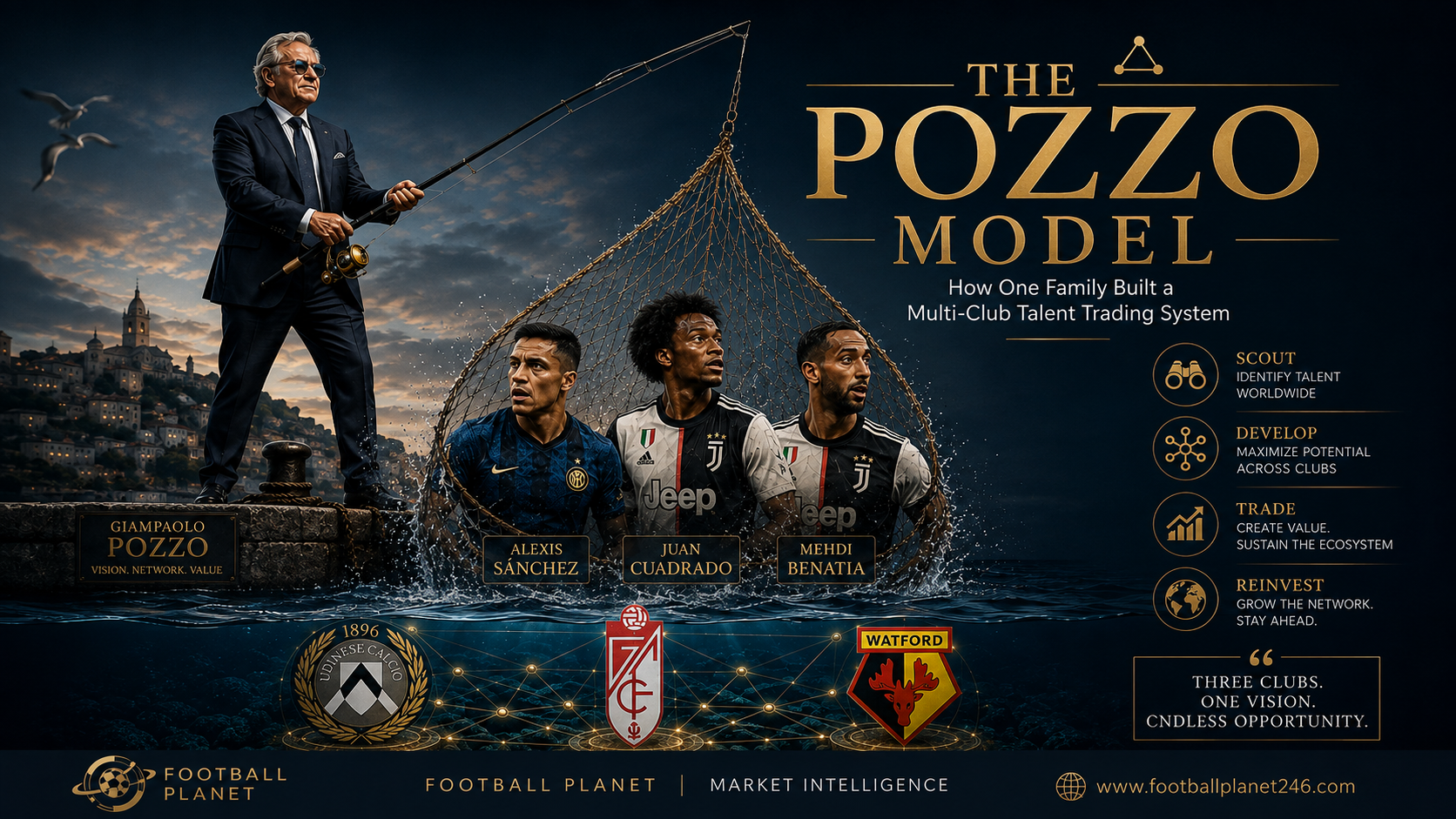
Beyond the Traditional Selling Club
European football has several clubs internationally recognised for identifying, developing and eventually selling talent at significant value. Benfica, Porto, Ajax and Dinamo Zagreb are among the most obvious examples. The Pozzo family, however, developed a different variation of the model. At Udinese, they built one of European football’s most distinctive selling-club structures around international scouting, early talent identification and disciplined player trading. Over time, that philosophy expanded beyond a single club and into different football environments through Granada in Spain and Watford in England. What began as a successful recruitment model gradually became a multi-club football ecosystem.
Udinese — The Foundation of the Model
The foundation was Udinese. Under the Pozzo family, the Italian club became widely associated with identifying players before their value was fully recognised by the wider market. International scouting became central to the strategy. Rather than consistently competing financially for established names, Udinese searched extensively for emerging or undervalued talent, provided players with a competitive Serie A environment and, when the timing was right, realised significant transfer value. The list of successful cases has included players such as Alexis Sánchez, Juan Cuadrado, Samir Handanović, Medhi Benatia and Piotr Zieliński. This was not simply about “buying cheap and selling high.” The competitive advantage came from repeatedly identifying future value before it became obvious. Udinese therefore became more than a selling club. It became the laboratory in which the Pozzo recruitment philosophy was refined.
From Udinese to Granada and Watford
The next stage was particularly interesting. Rather than keeping the model within one Italian club, the Pozzo family expanded into different football markets. Granada became part of the network in 2009, when the Spanish club was competing in Segunda División B. During the Pozzo era, the club eventually returned to La Liga, while recruitment and player movement were closely connected with the broader network. Watford followed in 2012. English football represented a completely different environment: greater commercial power, different competitive demands and significantly larger financial opportunities. The same underlying recruitment philosophy therefore had to be adapted rather than simply copied. The family’s controlling stake in Granada was eventually sold in 2016, but the Spanish period remains an important chapter in understanding how the model developed beyond Udinese.
The Recruitment Engine
At the centre of the Pozzo model sits a relatively clear value-creation cycle: Identification → Acquisition → Development → Playing Opportunity → Market Appreciation → Transfer.
International scouting increased the number of markets from which potential value could be identified. Multiple clubs created additional competitive environments in which players could potentially develop, adapt or receive playing opportunities. This mattered because recruitment success is rarely determined by identification alone. The right player also requires the right environment. A prospect may need Serie A tactical exposure, Spanish technical football or the physical and commercial environment of English football. The multi-club structure created greater flexibility around that pathway.
Why the Multi-Club Structure Mattered
This is where the Pozzo model became fundamentally different from the traditional selling club. A conventional selling club generally identifies, develops and transfers players within one institutional ecosystem. The Pozzo structure created several possible environments. Players could move between clubs according to sporting needs, development stage or squad opportunity. One clear example came in 2016, when Watford signed Abdoulaye Doucouré and immediately loaned him to Granada, while Adalberto Peñaranda moved in the opposite ownership structure but remained temporarily in Spain. This created potential advantages in:
- player development,
- squad management,
- market access,
- adaptation,
- and eventual transfer value.
It effectively connected recruitment strategy with portfolio management.
Strengths — and the Risks
The strengths of the model are clear. A strong international scouting network increases the probability of identifying undervalued talent. Early recruitment can reduce acquisition costs. Multiple development environments can create flexibility, while successful player trading can generate the resources required to repeat the process. But the model also contains risks. High player turnover can affect continuity. Recruitment mistakes become expensive when the entire strategy depends heavily on identification accuracy. A player who succeeds in one league may not adapt to another. Multi-club structures also operate in an increasingly complex regulatory environment and require careful management of sporting integrity, player pathways and club identity. The Pozzo model should therefore not be viewed as a perfect formula. Its value lies in understanding how several strategic components can work together.
Final Thoughts — From Selling Club to Football Ecosystem
Udinese demonstrated that a club outside Europe’s financial elite could create a competitive advantage through scouting, development and player trading. The Pozzo family then extended that philosophy. Granada and Watford introduced additional markets, development environments and commercial possibilities, transforming a successful selling-club philosophy into something closer to a multi-club talent ecosystem. The broader lesson for football recruitment is not that every club should copy the Pozzo structure. It is that sustainable value can be created when scouting, timing, development environment and market strategy operate as one system. The football industry often focuses on the final transfer fee. The more interesting question is how that value was identified and created long before the sale. At Football Planet, Market Intelligence means understanding exactly that process.