How Institutional Capital Is Reshaping European Football
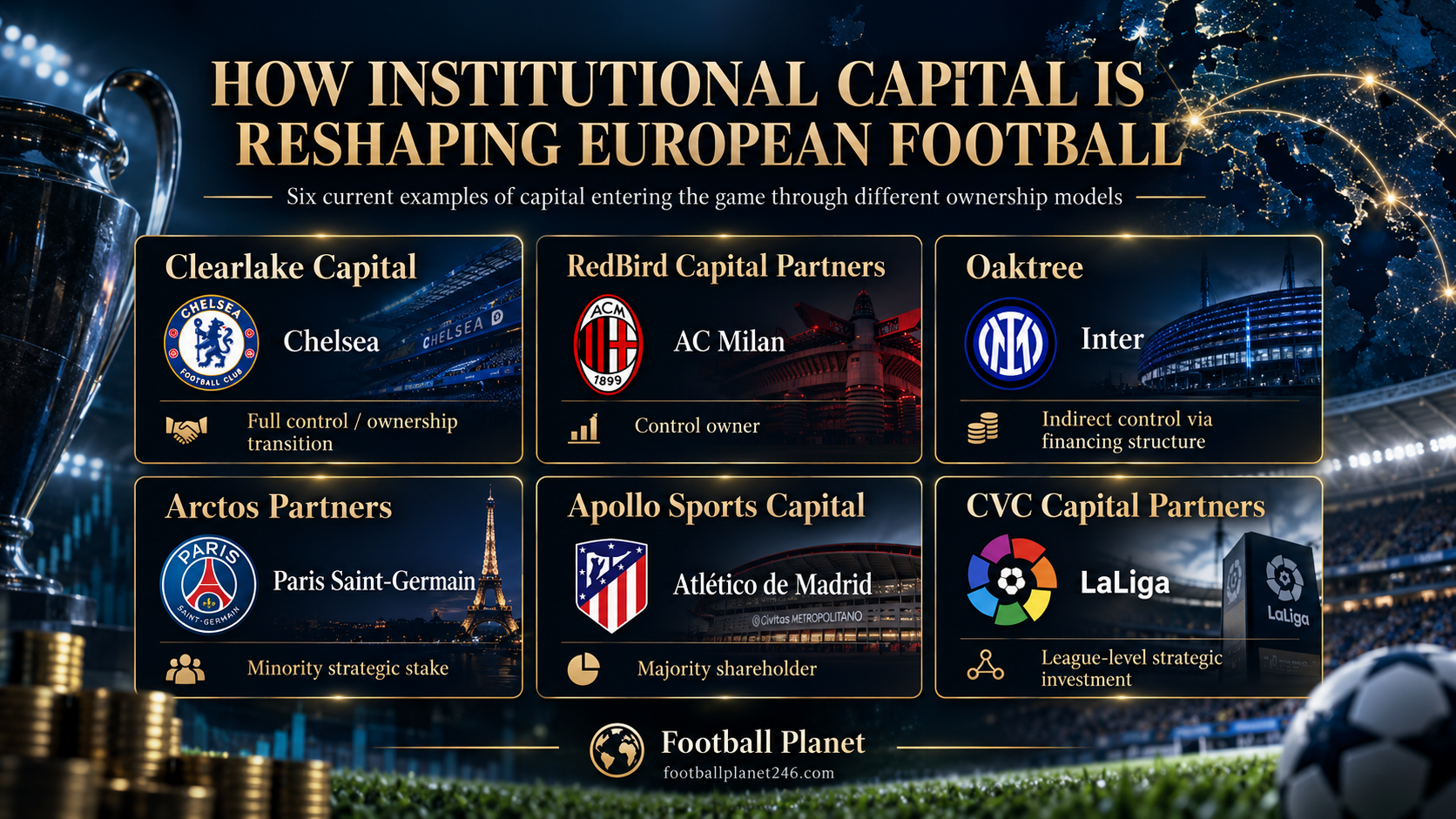
Football ownership is changing.
The game is no longer attracting only wealthy individuals, family owners or state-backed groups. Increasingly, private equity firms, asset managers and institutional investors are entering football through majority ownership, minority stakes, financing structures and league-level partnerships.
The important point is that there is no single model.
Capital is entering the game in different ways — and for different reasons.
Clearlake Capital — Chelsea
Clearlake Capital first entered Chelsea’s ownership structure in 2022 alongside Todd Boehly and other investors.
In September 2026, Chelsea announced that Clearlake would acquire the interests of both Todd Boehly and Mark Walter, giving the firm full control of the club.
The club said the ownership group had invested across senior teams, academy development, training facilities and football operations. Chelsea FC
RedBird Capital Partners — AC Milan
RedBird completed its acquisition of AC Milan in 2022 in a deal valuing the club at €1.2 billion.
Its model has been positioned around long-term ownership combined with operational expertise across sport, media and entertainment. AC Milan has also highlighted investment in commercial growth, infrastructure and the club’s long-term financial sustainability. AC Milan
Oaktree — Inter
Oaktree’s path into Inter was different.
In 2024, the investment manager acquired indirect control of 99.6% of Inter after enforcement of a share pledge linked to the club’s previous ownership structure.
It is a useful example of how institutional capital can enter football not only through direct acquisition, but also through financing and credit structures. Inter
Arctos Partners — Paris Saint-Germain
Arctos acquired a minority stake in PSG in 2023. The partnership was presented as strategic capital to support global growth, operations, international expansion and real-estate initiatives linked to the club’s stadium and training infrastructure. Paris Saint-Germain
Apollo Sports Capital — Atlético Madrid
Atlético Madrid offers another current example.
Apollo Sports Capital became the club’s majority shareholder following the formalisation of an agreement announced in 2026. Atlético also approved up to €100 million in additional strategic capital for team and infrastructure investment. Club Atlético de Madrid
CVC — LaLiga
CVC shows that institutional investment does not always require owning a club.
Through LaLiga Impulso, CVC committed €1.994 billion to support club and league growth in areas including infrastructure, digitalisation, internationalisation and technology.
CVC also holds an 8.2% stake in LaLiga Group International, the company coordinating the project. Página web oficial de LALIGA | LALIGA
The Football Planet Perspective
The pattern is becoming increasingly clear.
Institutional investors are not entering football through one single route.
Some seek control.
Others take minority positions.
Some provide strategic capital.
Others participate through league-level structures or financing arrangements.
What connects these models is the belief that football clubs and competitions are more than sporting organisations.
They are global brands, media properties, commercial platforms and long-term assets.
Capital may open the door.
The real value depends on what happens after the investment.