Why Belgium Became a Gateway for Asian Football Capital
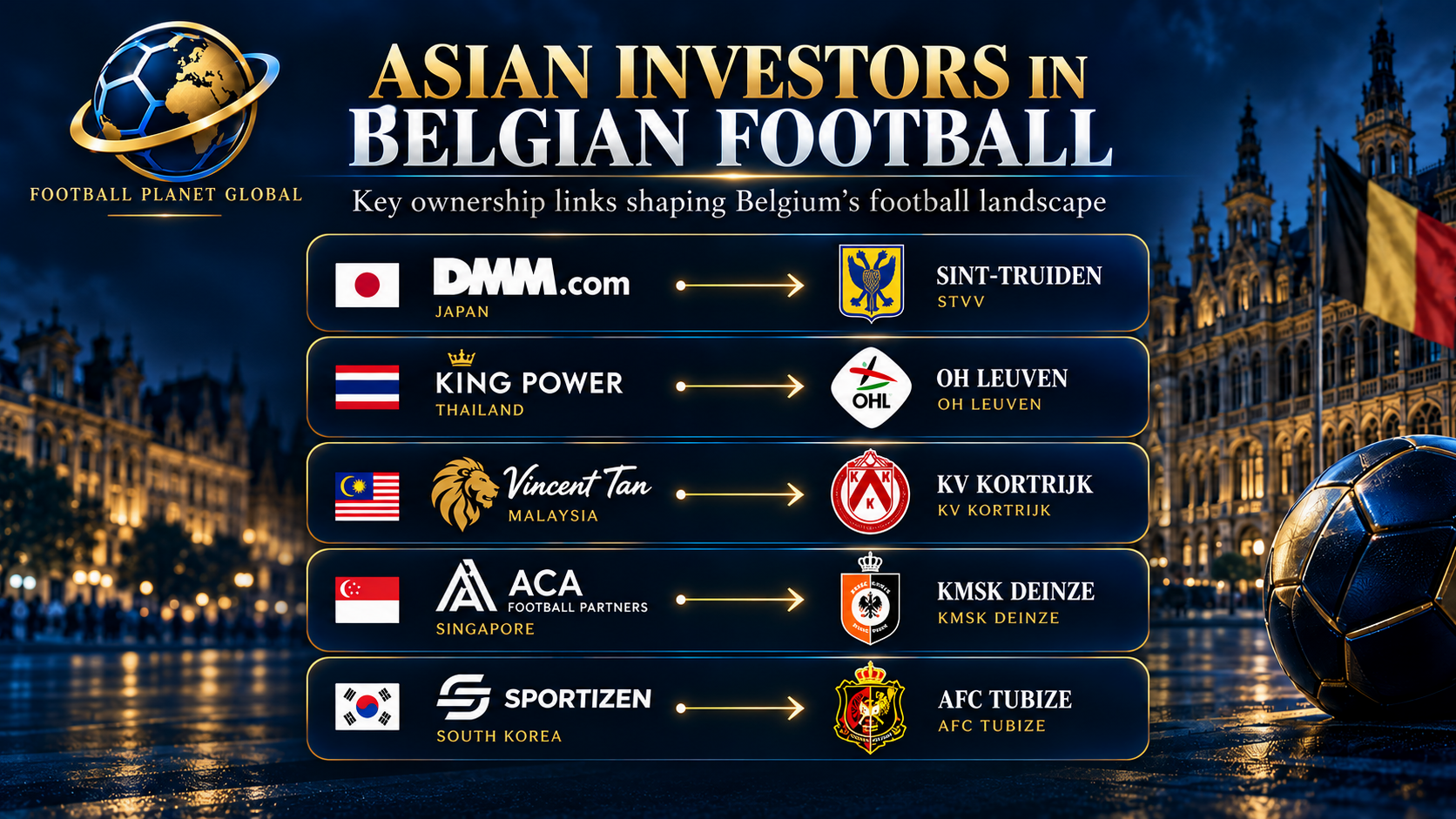
Belgian football has quietly developed a distinctive role within the European game.
It is not one of the continent’s five biggest leagues, yet over the last decade it has attracted ownership and investment from Japan, Thailand, Malaysia, South Korea and Singapore-linked football groups.
The common thread is bigger than club ownership.
For several Asian investors, Belgium has offered something particularly valuable: a manageable entry point into European football combined with access to player development, scouting networks and larger transfer markets.
STVV: Building a Japan–Europe Bridge
One of the clearest examples is Sint-Truiden.
Japanese digital group DMM.com acquired control of STVV in 2017. At the time, the club explicitly described its ambition to act as a bridge between Japan and Belgium while using DMM’s network to strengthen recruitment and youth development. (STVV(シント=トロイデンVV)日本公式サイト)
The strategy soon became visible on the pitch.
Japanese players increasingly used STVV as a European platform, with Takehiro Tomiyasu among the most recognisable examples after joining the club from Avispa Fukuoka in 2018. (STVV(シント=トロイデンVV)日本公式サイト)
This was not simply foreign ownership. It was the creation of a player pathway between two football markets.
King Power and OH Leuven
Thailand’s King Power completed a 92% takeover of OH Leuven in 2017, adding the Belgian club to a football portfolio already connected with Leicester City. (Amazon Web Services, Inc.)
Since the takeover, OH Leuven says King Power has made sustained investment across the first team, facilities, infrastructure, organisation and academy. The club has increasingly emphasised developing its own players and creating future transfer value as part of a more sustainable model. (Oud-Heverlee Leuven)
Here, Belgium functions not only as a competitive market but also as a long-term development platform.
Malaysia and South Korea Enter the Market
Malaysian businessman Vincent Tan has controlled KV Kortrijk since 2015, and remains the club’s owner today. (KV Kortrijk)
South Korea provided another early example.
Sports marketing company Sportizen acquired AFC Tubize in 2014. Its CEO openly cited Belgium’s central European location and its relatively open environment for recruiting foreign players as reasons for choosing the market. The company also saw Tubize as a potential pathway for Korean players into European football. (Yonhap News)
Sportizen gradually exited between 2018 and 2019, illustrating an important point: foreign investment does not automatically create long-term sporting stability. (afctubize.be)
The Deinze Experiment
In 2022, Singapore-based ACA Football Partners acquired KMSK Deinze and explicitly positioned the club at the centre of a multi-club strategy designed to connect Europe and Asia. Partnerships followed with organisations in Vietnam, Singapore and Japan, with a strong emphasis on youth development and player pathways. (ACA Football Partners)
But the project also demonstrates the risks.
KMSK Deinze was declared bankrupt in December 2024. (Faillissementsdossier)
That makes the Belgian story more complex — and more valuable to study.
Why Belgium?
Belgium offers several characteristics attractive to international investors:
European location. Player-development reputation. Strong scouting visibility. Access to neighbouring major leagues. And historically, a comparatively open environment for international players.
For Asian ownership groups, that combination can make Belgium more than simply another football market.
It can become a gateway.
But the examples also show that capital alone is not enough.
STVV, OH Leuven, Kortrijk, Tubize and Deinze represent different outcomes and different strategies.
The broader lesson is clear:
Belgium can provide the platform.
Sustainable football intelligence, player development and governance determine what investors build on it.