Possession Dominance: Who Controls the Ball — and Does It Really Matter?
Ball Control and Competitive Performance
Possession remains one of football's most widely discussed performance indicators. It is frequently associated with tactical dominance, technical superiority and the ability to control matches.
But does controlling the ball necessarily mean controlling the result?
An examination of the 2026–27 season across Europe's five major domestic leagues reveals significant differences between possession dominance and competitive effectiveness.
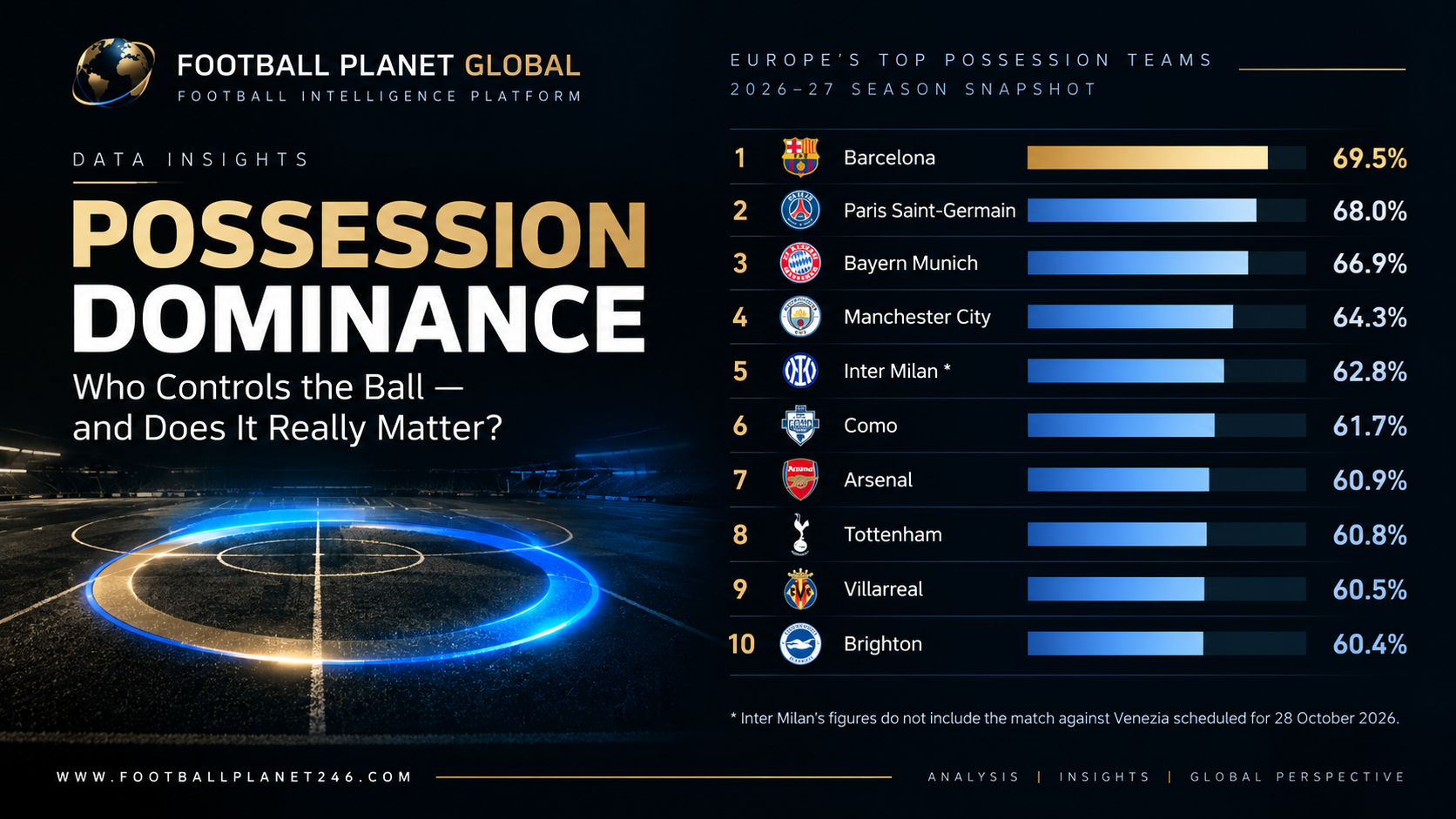
According to StatMuse's European possession data, Barcelona lead the comparison with 69.5% average possession, followed by Paris Saint-Germain (68.0%), Bayern Munich (66.9%), Manchester City (64.3%) and Inter Milan* (62.8%).
Como have also emerged among the leading possession-oriented teams, averaging 61.7% across their opening nine Serie A matches.
These figures provide an early-season snapshot rather than a worldwide ranking.
High Possession, Different Results
Barcelona offer a compelling example of possession combined with attacking productivity.
Across their first ten La Liga matches, the Catalan club recorded nine victories, scored 40 goals and generated 34.91 expected goals (xG).
Manchester City similarly combined 64.3% possession with seven victories from eight Premier League matches.
However, possession does not guarantee comparable outcomes.
Arsenal and Tottenham provide a particularly revealing contrast.
Arsenal recorded 60.9% average possession and seven victories in eight league matches, producing 14.00 xG.
Tottenham maintained an almost identical possession rate of 60.8%, yet recorded only two victories and generated 8.08 xG over the same number of matches.
The difference illustrates why possession percentages must be evaluated alongside attacking output and overall performance. (StatMuse – European Possession and Performance Statistics)
Como: A Rising Example of Possession-Based Football
Under Cesc Fàbregas, Como provide another interesting case in the relationship between ball control and attacking effectiveness.
The Italian club's average possession increased to 61.7% following their 3–1 away victory over Torino on 27 October 2026.
In that match, Como recorded approximately 72% possession and 18 shots, overturning a first-half deficit through goals from Jacobo Ramón, Nico Paz and Martin Baturina.
The result strengthened Como's record to six victories in nine league matches, representing a 66.7% win rate.
While one match cannot establish a direct causal relationship between possession and success, Como's performance demonstrates how sustained territorial control can accompany attacking pressure and goal creation. (Lega Serie A – Torino 1–3 Como)
Possession Is Not the Same as Attacking Quality
Expected goals offer an additional perspective on the effectiveness of possession-based football.
Barcelona's 34.91 xG across ten matches represents approximately 3.49 xG per game.
By comparison, Tottenham's 8.08 xG across eight matches represents approximately 1.01 xG per game.
These figures reveal differences in chance production, although they do not prove that possession itself causes attacking success.
The effectiveness of ball control depends on how teams use possession, where they progress the ball and whether their attacking movements create high-quality opportunities.
A side maintaining 65% possession may struggle to penetrate an organised defensive block. Another team with less than 45% possession may generate dangerous chances through rapid transitions and vertical passing.
Why Tactical Context Matters
Possession statistics are also influenced by opposition quality, match circumstances and tactical priorities.
Teams protecting a lead may deliberately concede territory, while those chasing a result often accumulate possession against deeper defensive structures.
For analysts and recruitment departments, this distinction is essential.
Players operating in possession-dominant systems may benefit from consistent passing options, advanced positioning and greater territorial control.
Their individual performances should therefore be evaluated within the tactical environment rather than through isolated statistics.
The Football Planet Perspective
The early stages of the 2026–27 season reinforce an important principle: possession dominance and competitive effectiveness are connected, but they are not interchangeable.
Barcelona, Manchester City and Arsenal demonstrate how ball control can coexist with strong results.
Tottenham's contrasting record highlights why possession must be assessed alongside attacking productivity, defensive organisation and tactical execution.
Como provide an additional example of a developing possession-oriented identity supported by positive results.
Possession tells us who controls the ball. Performance analysis reveals what teams achieve with that control.
For modern football intelligence, understanding this distinction is more valuable than possession percentage alone.
Statistical Note & Methodology
This analysis covers domestic league matches in Europe's five major championships during the 2026–27 season, using a statistical snapshot accessed on 28 October 2026, before the completion of that day's fixtures.
*Inter Milan's figures exclude the away match against Venezia scheduled for 28 October 2026.
Season statistics: StatMuse – European Football Statistics.
Como match result: Lega Serie A – Torino 1–3 Como.
Como match statistics: Torino–Como Match Statistics.
Possession percentages, results and expected goals reflect the available data at the time of analysis. Figures may change following subsequent matches or data-provider revisions.