Before Data: How Italian Scouting Discovered Vieri and Del Piero
Before Algorithms, There Were Observers
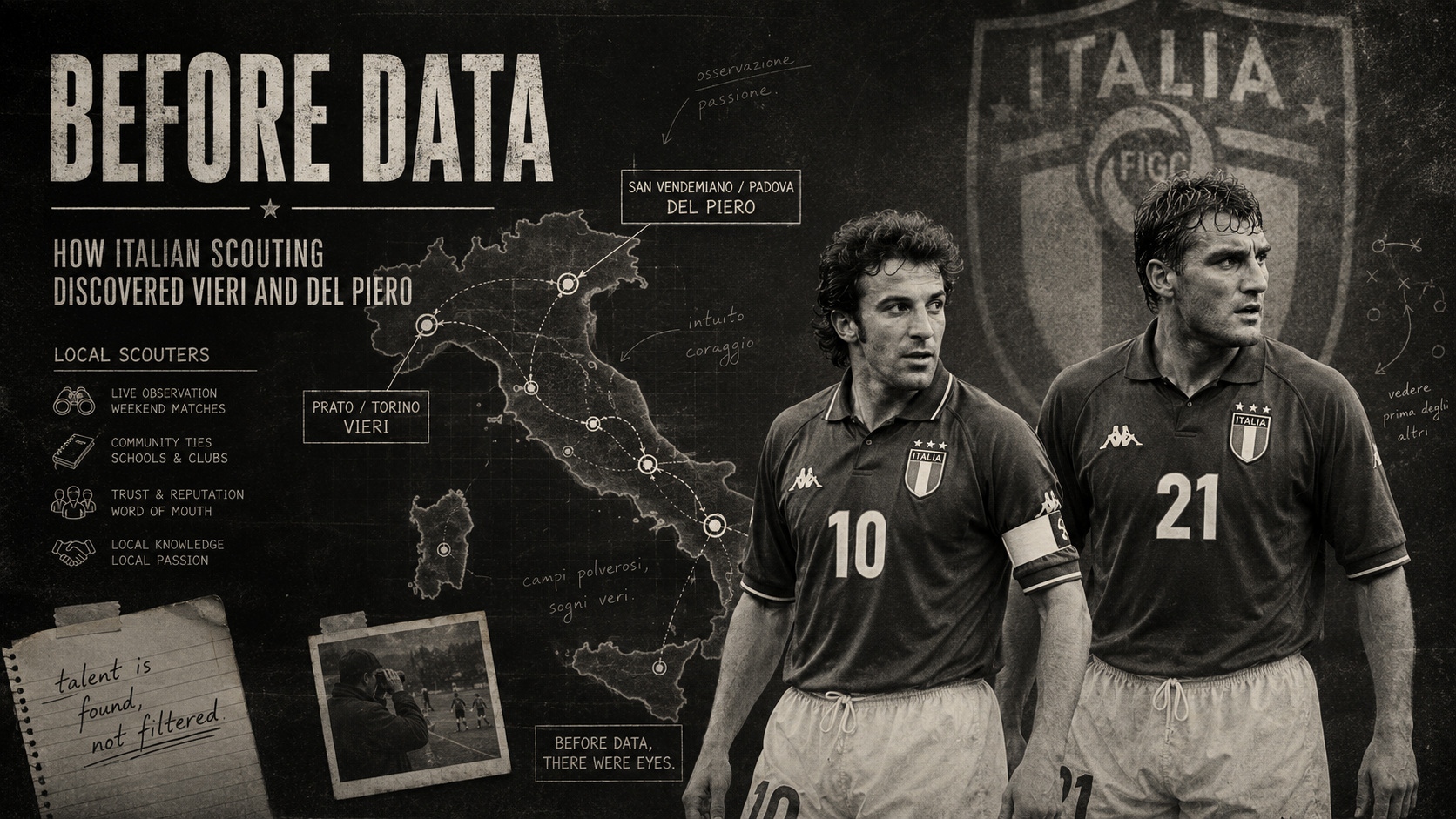
Long before Wyscout, event data and global player databases, scouting depended on something far more limited — and far more human. Italian clubs relied heavily on live observation, regional knowledge, youth competitions and experienced observers capable of recognising qualities that were not yet obvious to the wider market. The discoveries of Alessandro Del Piero and Christian Vieri offer two different windows into that world. Their pathways were not identical, but both show how Italian scouting in the late 1980s and early 1990s connected local football with increasingly structured professional youth systems.
Del Piero: A Scout, a Provincial Match and a Life-Changing Observation
One of the clearest examples comes from Del Piero. On 10 November 1987, one day after his 13th birthday, Padova scout Vittorio Scantamburlo watched him play for San Vendemiano in a provincial Giovanissimi match. Del Piero later recalled the arrival of Scantamburlo at that match as an event that changed his life. Padova also credited Scantamburlo with identifying more than 70 players who would eventually become professionals during his long association with the club. The story captures the reality of scouting before digital platforms. Talent discovery could depend on an experienced observer travelling to a small local match, watching a teenager in context and deciding that what he was seeing deserved another level of attention.
What Scouts Were Actually Looking For
The process was not necessarily primitive simply because the technology was limited. A surviving scouting account of Del Piero from 1991, when he was still a teenager at Padova, assessed much more than physical qualities. The evaluation focused on technical ability, tactical understanding, vision, use of both feet, game intelligence, adaptability and willingness to contribute to the team. That distinction matters. Modern scouting has added enormous amounts of information, but the core questions were already familiar: Can the player understand the game? Can he solve problems under pressure? Does his technique survive against stronger opposition? And can his qualities project to a higher level?
Vieri: The Importance of the Development Chain
Christian Vieri represents a different type of scouting story. After spending much of his childhood in Australia, he returned to Italy and passed through smaller football environments before joining Prato and later entering Torino’s youth structure. Torino’s academy under Sergio Vatta became one of the most productive development environments in Italian football. The FIGC credits Vatta with helping bring more than 60 players into Serie A, including Vieri, Dino Baggio, Diego Fuser and Gianluigi Lentini. Vieri’s pathway therefore illustrates another fundamental part of traditional scouting:
identification was only the beginning.
A talented player still needed the right development environment, competitive exposure and progression pathway before his potential could become professional value.
Italy’s Territorial Scouting Network
By the beginning of the 1990s, Italian clubs were also becoming more systematic in how they searched for young players. Former Juventus captain Giuseppe Furino later described changes introduced at Juventus in 1991 that included stronger recruitment across the territory, additional observers and greater organisation around the youth sector. At the same time, Italy already had increasingly structured youth competitions. The FIGC introduced national competitions for professional-club Allievi in 1982–83 and Giovanissimi in 1983–84, giving clubs more organised environments in which young players could be watched and compared. This created a scouting ecosystem built around territory. Local clubs developed players. Regional observers identified them. Professional academies recruited them. Youth competitions then provided the next level of evaluation.
The Scout’s Competitive Advantage Was Information
Today, almost every professional club can access enormous amounts of football information. In the 1980s and 1990s, information itself was scarce. A scout who knew a province, understood the local clubs and maintained trusted relationships could therefore possess information that competitors simply did not have. That made regional knowledge particularly valuable. The competitive advantage was not the ability to process millions of data points. It was knowing where to look, who to trust and what to recognise when the player finally appeared in front of you.
From Notebook to Database
Scouting has changed dramatically since Del Piero and Vieri were emerging. Video platforms allow scouts to watch players across continents within minutes. Data can filter thousands of profiles. Recruitment departments can compare physical, technical and event information at a scale that would have been impossible three decades ago. The profession itself has also become more formalised. The Italian federation now provides dedicated observer education through Coverciano, including scouting methodology, match analysis and data-related learning. But technology has mainly changed the scale and speed of the process. It has not eliminated the need for judgement.
What Modern Scouting Can Still Learn
The Del Piero and Vieri stories remain relevant because they highlight principles that technology cannot completely replace. A player must still be understood within context. Potential must still be projected rather than simply measured. Development environment still matters. And the best recruitment decisions often happen before the wider market reaches the same conclusion. The tools are different. The fundamental challenge is not.
Final Thoughts — The Question Has Never Really Changed
Scouting in Italy during the 1980s and 1990s operated in a football world with far less information. Observers travelled, watched, compared and relied heavily on experience and regional knowledge. Today, recruitment departments can access more information about more players than ever before. Yet the ultimate competitive advantage remains remarkably familiar: Can you recognise future value before everybody else does? That was the challenge when Del Piero was playing provincial youth football. It was the challenge when Vieri was progressing through Italy’s development system. And despite everything technology has changed, it remains the central question in scouting today.